
 Science
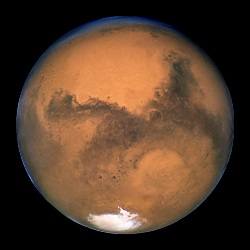
NASA scientists have found evidence of water on the Red Planet.
According to them, characteristic bands were found, which, as a rule, form after the glass has water and salts have deposited.
It appears that water started flowing from cliffs, canyons, and crater walls during the summer months.
This data gives scientists a chance to find life on Mars.
Small streams of water leave dark spots on the planet's surface. Scientists have calculated that these spots are several hundred meters long.
They also found that water begins to flow during the warmer months, and by autumn, when the temperature drops, these places dry out.
Judging by the images from the orbit of Mars, you can see the veins of water flows on the cliffs and steep walls of craters. In places where water flowed most abundantly, you can see intricate drawings.
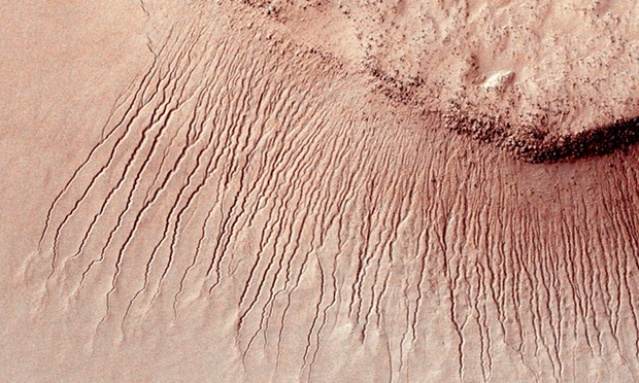
It should be noted that the average temperature on the Red Planet is about -62 C, and in summer it can reach +21C. Scientists have noticed that smudges on craters appear at a time when the temperature on the surface of Mars is high enough for water to flow through it.
It should be noted that water on Mars flows only when the temperature on the planet's surface rises above -23C. Water is able to flow at such a low temperature due to salts that reduce the freezing point of water.
Scientists don't yet know where the water came from, but it may have risen from underground ice, salty aquifers, or condensed from Mars' thin atmosphere.
Read also: Water flows on the equator of Mars
Is there life on Mars
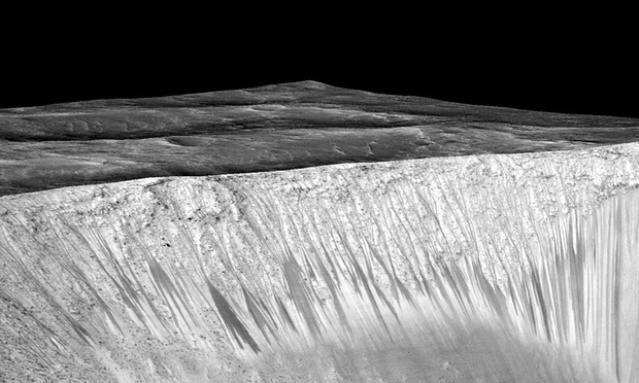
The evidence found for the existence of water could push various space agencies to search for life on the Red Planet. In addition, scientists will look for ways to land a person near places where there is water.
Scientists assume that water interacts with perchlorates to form a saline solution that flows down the slope.
John Bridges, professor of planetary science at the University of Leicester, believes that although this discovery can help find life on Mars, it will be extremely difficult to ensure that the devices are sterile, and this means that terrestrial microbes can enter this planet, thereby endangering local microorganisms.
Read also: Where did the rivers on Mars come from and where did they go?
The origin of water on the Red Planet
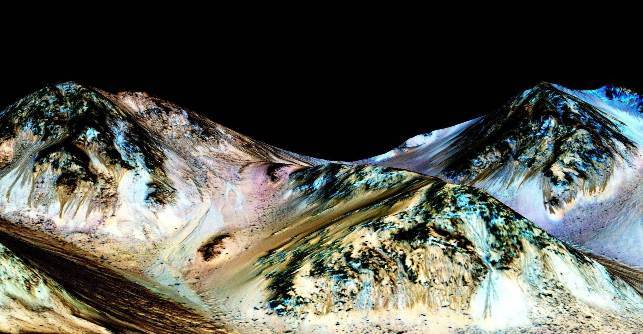
At this stage, scientists are trying to find out the origin of water on Mars. So far, there are 3 theories related to this:
1. Porous rocks under the Martian surface may contain frozen water that melts in summer and comes to the surface.
2. Highly concentrated salt aquifers located under the planet's surface in the form of sandy rocks saturated with liquid. While this theory may explain water smudges in some places on the planet, it does not explain how water seeps to the surface and begins to flow from the top of the crater walls.
3. The most likely theory is that salts on Mars begin to absorb water from the atmosphere until its concentration is so high that it begins to flow down the slopes. A similar process can be observed in the Atacama Desert, the driest desert on Earth, where the only habitat for living organisms is the subsoil layer.
Read also: Life on Mars? Curiosity rover discovers methane, water and organic molecules
NASA scientists' report (video)