
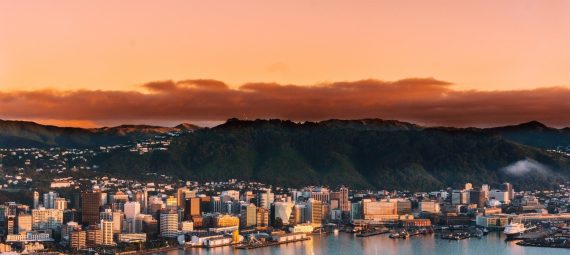
Wellington is the capital of New Zealand, the second most populous city in the country and the largest capital among the countries of Polynesia. The city is also known by its name in the indigenous language Te Fanaui-a-Tara (Maori Te Whanganui-a-Tara).
Natural conditions
Wellington is located in the south of the North Island, on the shore of the bay of volcanic origin Lambton Harbor, which is part of the Cook Strait. Because of this, the city is often exposed to strong storm winds. The capital is surrounded by hills. The climate is subtropical marine. The average temperature in January is +16, and in July — about +8 degrees. An average of 1,445 mm of precipitation falls per year, mainly in the form of rains. It snows only high in the mountains. The city is recognized as earthquake-prone. The natural vegetation is represented by trees and shrubs, among which evergreen species predominate.
History of development
At the beginning of the XIX century, the process of European seizure of the lands of the indigenous Maori population began. In 1839, Colonel William Wakefield, who served in the New Zealand Company, founded the city a little to the north of its present location. However, in 1840, strong floods of the Hutt River forced them to move south. The first settlers named the city Wellington in honor of Field Marshal Duke Arthur Wellesley Wellington, commander of the united Anglo-Dutch troops, in gratitude for the help he provided to the first settlers. Strong earthquake of 1848 it caused serious destruction in the city, and in 1854 many people died for the same reason. In 1865, Wellington became the capital of New Zealand, which it has been ever since.
Cultural significance
Wellington is an extraordinarily beautiful and cozy city, striking with an abundance of bridges, viaducts, tunnels, parks and squares. Its architectural appearance is diverse: electric structures dating back to the XIX — first half of the XX centuries, on the streets of the city are combined with modern-style buildings and mass wooden buildings. One of the most interesting buildings of the capital is the round parliament building, which the townspeople call a beehive. Opposite the Parliament is the former government palace, which is the second largest wooden building in the world. St. Paul’s Cathedral also attracts attention. The capital’s botanical garden, which is located on the slope of a high mountain, is impressive.