
Madrid is the capital and cultural center of Spain.
It reminded me of a resort town: narrow streets, palm trees and heat-soaked people. Unless there is no sea nearby. Madrid also gives the impression of a very overgrown Spanish village. It is worth turning off the central streets, as you get into atmospheric courtyards with one-way traffic. The roads there are so narrow that even one car has to fold mirrors.
With a transfer in Madrid, they fly to Central and South America. I went to Madrid for a marathon. After that, I studied the city for several days and made up a route for 7 km, along which you can quickly walk and not miss anything important. The walk starts from Retiro Park and ends with an observation deck next to the Debod Temple. On the way we will visit the Crystal Palace, pass by the Alcala Gate and the Telecommunications Palace, visit the Prado Museum, Plaza Mayor Square, San Miguel Market and the Royal Palace.
The most convenient way to get from the airport to the city is by metro. It comes straight from the terminals. There are no single tickets — you will have to buy a reusable transport card for 2.5 €. It is issued by the machine when buying a ticket. Surprisingly, it cannot be returned.
A trip around the city costs 2 €, another 3 € will be charged for leaving the airport area. In total, without taking into account the map, the road in one direction will cost 5 €.
Route
Retiro Park is a large park in the city center. It is very clean and quiet. This is a distinctive feature of all the parks of Madrid and the city as a whole. How they achieved this is a mystery to me: during the whole trip I did not see a single cleaner or a car collecting garbage.
In my opinion, Retiro looks like a model recreation park. Here people walk with their families, ride, play on the grass and read. Some parks remind me of outdoor shopping malls: it seems that vacationers are constantly trying to sell something. There is no such thing in Retiro.
You can take a boat ride on the pond of the park. I didn’t even recognize the prices: it’s much more comfortable to sit on the shore, in the shade of trees near the monument to Alfonso XII
Crystal Palace is a small greenhouse by a pond with a fountain in Retiro Park. From the floor to the roof, it is covered with glass. In the sun, it glitters along with the water, and the building looks insanely beautiful.
Small conceptual exhibitions are held inside. When I was there, there were 4 sculptures in it, but the palace itself was closed. This did not prevent me from viewing the exhibition through the walls. Admission is free, opening hours are indicated on the website.
The Alcala Gate was once the main entrance to Madrid. It is located right at the exit of Retiro Park.
The first gate at this place stood to the west and was one of the five main entrances to the city. In 1778 they were rebuilt, and later the gate became a monument. A worthy place for a keepsake photo.
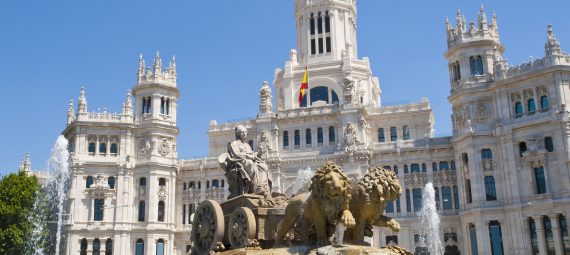
The Telecommunications Palace is one of the most beautiful and functional buildings in Madrid. The facade looks a little pompous and is full of decorative details. The interiors inside are like from a fashionable Instagram account: snow—white arches, ornate stucco and a huge glass roof.
Over a long history, the palace has performed various functions. Now there is a city hall, offices, exhibition halls, cafes and much more. Exhibitions are constantly changing — see their list on the website.
The palace is allowed free of charge, but at the entrance you need to pass a security check, as at the airport. There is an observation deck at the top, the entrance costs 3 €. The building is not very tall, but you can see the city, and the panoramas are pretty.
The Prado National Museum is a museum of European fine art. All the guidebooks I’ve read include the Prado in the top twenty most popular museums in the world.
The museum is huge. When you walk by, you think: “How much time does it take to explore its halls with a stroll?” The museum’s collection includes collections of paintings by Bosch, Velasquez, El Greco, Goya and other famous artists. Among the works there are a huge number of masterpieces that even a person as far from art as I have learned.
A ticket to the museum costs 15 €, admission is free in the last 2 hours of operation. You can check the schedule on the website. A long queue gathers for a free ticket, but it moves quickly.
Plaza Mayor — courtyard-a square with a statue of Philip III in the center. The square is surrounded by three-storey houses with 114 arches. This is an iconic place for Madrid. Since the 17th century, bullfighting and executions have been staged there. Now Christmas fairs and other standard entertainments for European cities are held on the square.
Tourists’ reviews of the Plaza Mayor are diametrically opposite. Some believe that the square is a teleport to the exquisite past. Others write that the Plaza Mayor is “a rookery of homeless people on mattresses around the perimeter.” As for me, this is the most ordinary European square, which is worth spending quite a bit of time on.
The San Miguel Market is located in the center of Madrid and is very popular among tourists. This is not the market where they sell one parsley and tomatoes, but a whole gastromarket. Here you can try sangria, tapas, paella, jamon, fresh oysters and much more. It didn’t seem to me that the prices bite: on average, a glass of wine costs 2 €, and a large and thick sandwich with jamon and other types of meat costs 3.5 €. It is difficult to master it even together.
The Royal Palace in Madrid is the official residence of the kings of Spain. Next to it is the Almudena Cathedral, Atenas Park and the Campo del Moro Gardens. To get acquainted with the palace from the inside and see how the Spanish kings live, you will have to pay 10 €. Sometimes the palace takes breaks from work, so it’s better to check the schedule on the website.
The entrance to the park and gardens is not restricted. But I didn’t get there: on the day of my visit to the Campo del Moro, construction work was underway and the gardens were closed.
The most beautiful and iconic buildings of Madrid and a stele dedicated to Miguel Cervantes stand on the Square of Spain. Cervantes is depicted as if he is watching his characters — Don Quixote of La Mancha and Sancho Panza.
The temple of Debod is an Egyptian temple of the 4th century BC. You don’t expect to see him in Madrid at all, but he’s really real. At the end of the 20th century, Egypt presented the temple to the Spanish authorities for their help in saving other Egyptian temples from flooding. The debode was carefully disassembled, transported to Madrid and reassembled.
Admission is free, but there is not much to see there: inside there are only frescoes, fragments of destroyed temples and a model of the Nile. Nevertheless, Debode is one of the most popular places in the city. The temple is located on a hill, and there is an observation deck right behind it. There is a magnificent view of the city from there. At sunset, a lot of people gather behind the Debode, who carefully sit down on the grass and watch the sun sink below the horizon.