
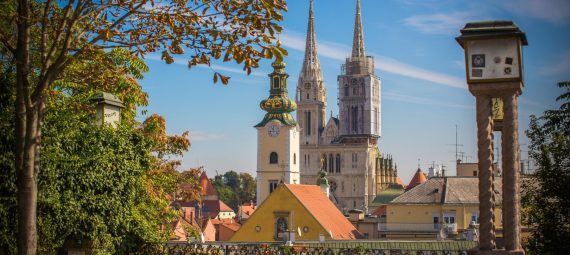
Zagreb is the largest city in Croatia and its capital. Together with the suburbs, more than 1 million people live here. Zagreb is located on the left bank of the Sava River, a tributary of the Danube, in the north-west of the country. Its history dates back more than 900 years, and most of the city’s medieval buildings are perfectly preserved. Every year Zagreb welcomes tourists from all over the world, for whom, in addition to museums and architectural monuments, several pedestrian zones have been created here, small cafes and cozy open-air restaurants work.
The cozy green and hilly Zagreb seems to be specially created for walking. Everyone who came here for the first time is especially impressed by the shopping street Ilica, located in the very center of the Croatian capital.
In the Upper Town, where the royal city of Hradec used to stand, there is the oldest architectural monument in Zagreb – a stone gate with a small chapel. They were built about 700 years ago – at the beginning of the XIII century.
Here you can also admire one of the main city symbols – the Cathedral of St. Stepan. It has existed since the XIII century and is famous for the fact that inside there are burials of all the hierarchs of the Croatian Church and the most notable people of the country. Not far from the main cathedral stands the Archbishop’s Palace – an architectural monument in the Baroque style.
In the upper part of Zagreb, it is interesting to visit the Church of St. Mark, which appeared here in the first half of the XIII century. The ancient temple is notable for its picturesque ceramic roof made of multicolored tiles. And the National Assembly Building and the Presidential Palace are located near it.
The blocks of the Lower part of the city are built according to urban planning plans of the second half of the XIX century. Travelers come here to admire the old representative mansions erected in the architectural traditions of neoclassicism and eclecticism, as well as to visit the equestrian monument to the first King of Croatia, which rises on Tomislav Square.
To see all the architectural styles in one place, it is enough to visit the main square of the Lower City, dedicated to Josip Jelacic. In its center there is a monument to Banu Yelachich. And the old square is surrounded by buildings representing the traditions of classicism, Baroque and modern architecture.
In the eastern part of the Croatian capital there is a very interesting palace and park ensemble “Maksimir”. This is a large-sized park, laid out in a traditional English layout in the XVIII-XIX centuries. Another historical and landscape monument of the city – the cemetery “Mirogoi” is considered one of the most picturesque parks in Europe. The most respected residents of Zagreb are buried on it.
Interesting facts about Zagreb
– One of the unusual symbols of the city are dragons. There are many medieval statues of reptiles and snakes in Zagreb. And for guests of the city, special tours are conducted to such attractions.
– The main grocery market of Dolac is called the “stomach of Zagreb”. It consists of two tiers – closed at the bottom and open at the top. Here you can try the famous paprenjak cookies, with additives of honey, walnuts and red pepper. It is also worth trying licitar gingerbread cookies, which are made in the form of a heart and decorated with icing. They are usually given as a sign of special love and affection.
– There is free wi-fi in the central part of Zagreb, the passwords to which are indicated on the city’s Facebook page. In addition, you can freely access the network from most hotels, cafes and museums.