
 Unbelievable facts
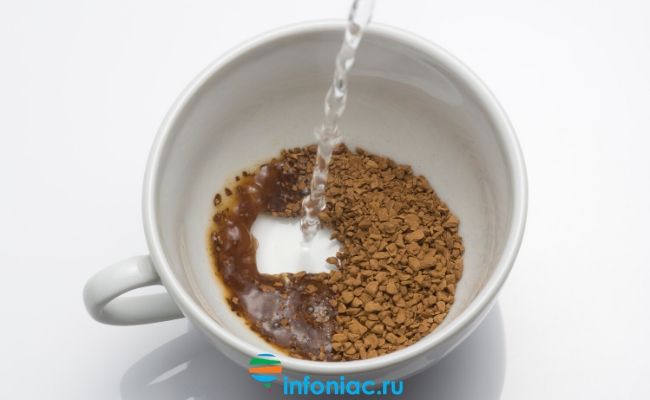
If you've ever had instant coffee, you'll be interested in learning some interesting things about these coffee crystals you dilute with water.
How does instant coffee differ from regular coffee?
10.
Less caffeine (30 to 90 g). In an ordinary cup of coffee, it can be from 70 to 140 g.
9.
More acrylamide is a chemical that is considered a possible carcinogen.
* Although acrylamide is produced naturally during the coffee roasting process, more of this substance is produced during the drying process. Still, it is believed that its quantity is safe for health.
Read also: What is the best time to drink coffee?
How did instant coffee become popular?
8.
Despite the fact that the first mention of a product similar to instant coffee dates back to 1771 and was recorded in England, the modern version was invented only 139 years later.
7.
The inventor and first to patent instant coffee was New Zealander David Strang. This happened in 1890.
It is believed that another inventor of instant coffee is the Japanese scientist Satori Kato, who worked in Chicago in 1901.
6.
In 1910, inventor George Washington introduced the first mass-produced instant coffee called Red E Coffee. This was the first commercial product of its kind.
5.
During World War I, the popularity of Red E Coffee (in tune with “ready coffee”) skyrocketed, all due to its convenience. The powder could be packed into envelopes and mixed with hot water for soldiers on the front lines.
4.
The most popular instant coffee brand in the world appeared in 1938. The joint work of Nestle and the Brazilian government, which tried to resolve the issue of the country's excess coffee, led to the creation of Nescafe. First, the product became popular in the US during World War II, and then in many other countries.
Read also: Why do you want to sleep after coffee?
What else might you not know about instant coffee?
3.
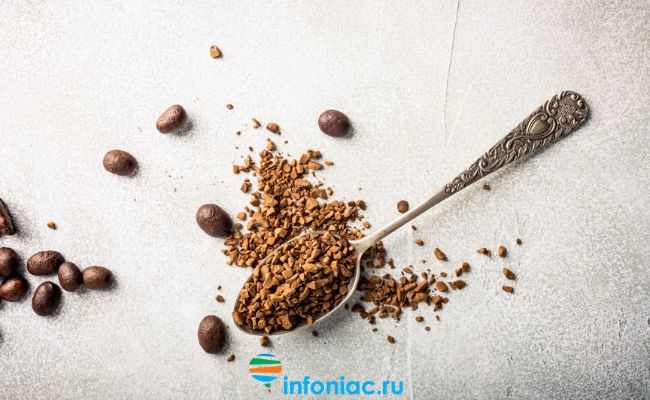
Instant coffee accounts for 13% of all coffee consumed in the world.
2.
Most instant coffee is made from robusta beans grown in Vietnam.
1.
In 2012, Canadian Masen Cancula set a world record by eating a tablespoon of coffee pellets in 8.61 seconds.
How does coffee turn into these pellets?
First, the harvested coffee beans are roasted, then ground, and then treated with hot water to obtain a concentrated drink.
After that, there are several options for drying coffee:
Powdered coffee (spray dried in English) is obtained thanks to the “spray drying” technology. This means that the coffee extract is dried by a stream of hot air, resulting in a powder.
Freeze-dried coffee (freeze dried in English) — it is dried using freezing. Thanks to freezing in vacuum, coffee crystals lose moisture. Coffee created by this method is more expensive due to the more expensive drying technology, but it has a more pleasant delicate smell.
Granulated coffee is created from a powder that is extracted using the spray-drying method due to aggregation — the coffee powder is wetted to produce granules.