
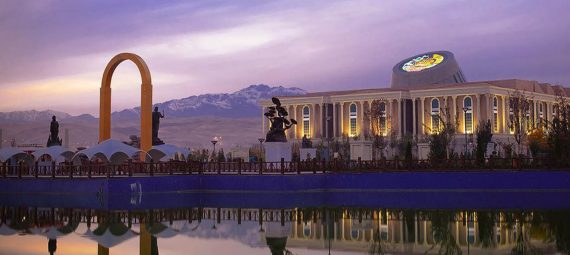
National Museum of Antiquities of Tajikistan
The history of the museum began with several hundred archaeological finds shown at the Exhibition of Achievements of the National Economy. Over time, the collection grew, but only the staff of the Academy of Sciences had access to it. Only in 1996 it became public. In 2001, the artifacts accumulated over decades were moved to a separate building, and the museum received its modern status and name. Its exposition covers the period from the 4th millennium BC (the era of ancient Sogda and Bactria) to the beginning of the 20th century.
St. Nicholas Cathedral
The Cathedral of the Russian Orthodox Church in Dushanbe was built in the 1940s. At that time, the church was persecuted, and churches were destroyed all over the USSR, all the more surprising that the authorities gave permission to build a new religious institution. Architecturally, the structure is quite simple, all the classical elements of church architecture are schematically designated and “Soviet-style” simplified.
As a result of the major reconstruction of the 2000s, the cathedral had gilded domes, a new altar and a landscaped adjacent territory.
Central Cathedral Mosque named after Hadji Yakuba
The mosque was built in the middle of the 19th century, and in the 2000s, as a result of an ambitious project, it was turned into one of the largest in Central Asia and the main temple of Dushanbe. During the construction, the medieval Islamic architecture characteristic of these places was taken as a basis: openwork mosaics on the walls, pointed arches of windows and passages, elegant minarets with sky-blue domes. The building turned out to be monumental and elegant at the same time. An Islamic cultural center and a university have been opened at the mosque.
Dushanbe Zoo
The zoo opened in 1961 and worked safely until the early 1990s. But as a result of the Civil War in Tajikistan, almost all of its inhabitants were killed. The restoration began only a few years after the end of hostilities. The collection is still being replenished, negotiations are underway with zoos of other countries on the transfer of animals. The employees are trying to improve the conditions of their detention as best they can, but so far most of the animals live in cages. In the near future, the territory is planned to be turned into a safari park.
Park of Culture and Recreation named after Abulkasim Firdavsi
The park is located in the southern part of the city around an artificial lake. Most recently, its general reconstruction was carried out, as a result of which new landscaped alleys, a roller rink, mini-football fields, a tennis court, a playground and an amphitheater appeared.