
Most tourists and even citizens mistakenly think that Central Park is the largest park in New York. However, this is not the case at all. Find out where in the city there are whoppers that overshadow Central Park.
Central Park is by far the largest park in Manhattan — it covers 843 acres, which is six percent of the entire island. But in other boroughs there are parks that can safely wipe the nose of the Manhattan legend.
1. Flushing Meadows-Corona Park
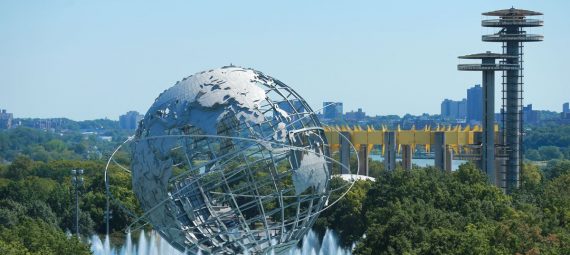
Flushing Meadows-Corona Park is not much bigger than Central Park — it covers 898 acres. But it proudly bears the title of the largest park in Queens. Queens residents can also be proud that the park was the site of the World’s Fair in 1939 and 1964 and that it has been the venue for U.S. open tennis tournaments for the past 50 years. Today, visitors to the park can still observe the remains of the World Exhibitions — the New York State Pavilion, Meadow and Willow Lakes, as well as the iconic Unisphere fountain. Around the famous globe, you can now see Zack Landsberg’s installation “Islands of the Unisphere”. Since Unisphere is a globe with recognizable continents, but without inscriptions and borders, Landsberg decided to expand this monument by depicting secluded islands and placing them horizontally on the grass. The islands are functional — you can sit on them, therefore, according to the author’s idea, they should encourage people to communicate, establish connections and reflect on the huge diversity of Queens.
2. Van Cortlandt Park
The Bronx consists of 25% parks. It is not surprising, because in this area of the city there are two of the largest parks in New York. Van Cortlandt Park, the smaller of the two, is located on more than 1,146 hectares. There are playing fields, playgrounds, lakes and dense forests.
The park is also rich in history: in addition to being the site of the 1778 Battle of Kingsbridge, the park also houses the Van Cortlandt House, the oldest house in the area where the museum is now located. In addition, during the Revolutionary War, the underground vaults of Van Cortlandt were used to store important records of New York.
3. Staten Island Greenbelt
As its name suggests, Greenbelt is a network of connected parks and trails spread over 2,800 acres that form a massive belt in the center of Staten Island. After the Verrazano Bridge opened in 1964, residents of Staten Island and nature lovers were afraid that the natural corners of the borough (and there were many of them at that time, including lakes, bolts and forests) would be destroyed for the construction of housing and infrastructure. Their fears were well-founded, as Robert Moses planned to extend the Richmond Parkway just through the place where High Rock Park is now located. In 1983, after 20 years of negotiations, Greenbelt finally received the status of a park, and hence immunity.
Ironically, Greenbelt Moses’ Mountain is named after the Parks Commissioner who opposed the existence of this park. The 260-foot mound of rocks and earth is made from a section of road cut off from the Staten Island Expressway, originally intended for the construction of the Richmond Parkway. Since Richmond Parkway was never expanded, the unused hill was gradually overgrown with grass and trees. In addition, in Greenbelt you can visit the Nature Center, ride the carousel, play golf and, of course, have a picnic.
4. Freshkills Park
Touted as the largest park created by the city in more than 100 years, Freshkills Park has been described by Staten Island Blue Guide author Carol Wright as a “monumental act of environmental remorse.” It will be completed by 2036, the former 2,200-acre landfill will be almost three times the size of Central Park, and despite the history of the area, will be able to “offer almost everything you can wish for in the park,” Wright writes.
According to the Fresh Kills Park Alliance, 30 cm of soil and protective geotextile cover the garbage that was previously taken to Staten Island. A network of underground pipes sucks out methane released from decomposing waste. This gas is then converted into natural gas to be used by National Grid.
5. Pelham Bay Park
The huge 2,765-acre Pelham Bay Park in the Bronx is the largest park in New York. As in other massive parks in the city, Pelham Bay Park has places for sports and excellent wild corners for nature lovers. But what sets it apart from other parks is Orchard Beach, the Bronx’s only public beach, an artificial ocean created by Robert Moses.
Long before becoming a holiday destination, the park was the site of a colony founded by Anne Hutchinson, a former Puritan settler. The land would later become part of the Pelham Estate, and during the Revolutionary War, the site of the Battle of Pell Point in 1776. Historians say that the remains of the stone walls that covered the American troops when they attacked the British can still be found in the golf course area.