
If Kaunas has already been explored by you along and across, we suggest you go to the west – along the picturesque route along Nemunas. On a 60-kilometer stretch, you will find a wonderful concentration of castles with a very different character.
Raudondvaris
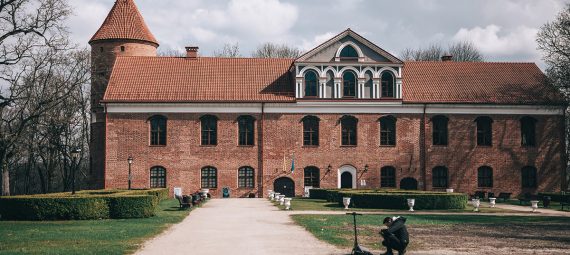
The first stop is the Kaunas suburb of Raudondvaris. A small village of 4,000 people was awarded a lengthy Wikipedia article – of course, because it was first mentioned in the annals already in the dusty year 1392. Local pagans then tried to chop the crusaders into dust, but it did not work. The Crusaders captured Zhemaitiya and founded a fortress on the island of the river Nevezha. Today you will not see a fortress here, but you will see the estate of Benedikt Tyshkevich – the same count who once deployed a luxurious photo lab in the Belarusian town of Vyaloe.
Before the Tyshkevichi, Raudondvaris was owned by the Radziwills, Gintovt-Dzevaltovsky, Varlovsky and Zabello. The castle acquired modern features under Prince Janusz Radziwill in the XVII century, and it was brought to mind by Benedikt Tyshkevich, who inherited the castle from Mikhail Tyshkevich in a very deplorable state: the Russian army was in charge here. After the reconstruction of 1832-1855, the castle is an architectural mix of Renaissance and Gothic (the round tower is just Gothic).
By order of Tyshkevich, stables, greenhouses and a greenhouse appeared in the estate, in which lemon trees were grown and alligators were kept. Today, a restaurant is located in this building. In the castle with the tower there is a Museum of the Kaunas district.
In addition to the Red Courtyard, the color of the brick of which gave the name to the whole place, in the village it is worth taking a look at the Šv. Kūdikėlio Jėzaus Teresės bažnyčia. However, this is no longer the building that Tyshkevich himself visited to pray, but the construction of the first third of the twentieth century was in an eclectic style.
Vilkija
The place has grown spectacularly on a hill, and above all, of course, there is a temple – Šv. Jurgio bažnyčia. This neo-Gothic building of the twentieth century survived several pastors who were engaged in it, and several scandals related to the funds raised for its construction, but in the end the selfless work of the parishioners (and, according to local legend, a tamed bear) gave a brilliant result. Such a crowd gathered for the consecration of the temple as Vilkia had never seen before or since. Opposite the temple you will find a stylized map of the village with its highlights.
Among these important points is the Museum of Ethnic Culture of Antanas and Jonas Yushek. In the 1862-1864’s in this pretty house (the building is generally said to be 300 years old) there was a famous priest, folklorist, ethnographer and linguist Antanas Yushka, who collected old Lithuanian songs and melodies. The thematic museum was opened here in 1989, perpetuating the memory of Jonas Yushka in its name – Antanas’ brother was a prominent linguist, he was the first who was professionally interested in the connection of the Lithuanian language and Sanskrit. In the museum you can examine objects of ancient Lithuanian life. It will be absolutely perfect if you get here for some holiday or temporary exhibition.
In Vilkia, not only their scientists are honored, but also book smugglers: their graves in the old cemetery (senosios Vilkijos kapinės) are diligently examined by the locals and visited on big holidays. The fact is that the Russian Empire strictly prohibited the distribution of books in the Lithuanian language, typed in the Latin alphabet. The ban was in effect from 1864 to 1904, and all this time fearless scribes, risking to go into Siberian exile, imported “proscribed”. The books were distributed by secret organizations and invariably found their devoted readers.
In Vilkia, you should definitely hang out at the Neman – go down to Vilkijos parkas, where, if you’re lucky, you’ll find the ferry crossing working, but it’s nice here without it. The park has an amphitheater dedicated to jazz musician Louis Armstrong, and this is not for nothing: a Jewish couple Karnovsky (Karnofsky) once lived in Vilkia, these people, having moved to New Orleans, sheltered a stray boy – and he, when he grew up and became a star of the first magnitude, the great Louis Armstrong, in memory of their kindness wore a pendant with a six-pointed star. You can listen to this guy’s music in Vilkiysky Park: press the buttons of the structures near the benches – and enjoy the vibes “What a Wonderful World” and “Summertime” (duet with Ella Fitzgerald).
Seredžius
After admiring the Neman from the shore, go to the town of Seregius to watch the movement of the river from a height. The Neman so sedately absorbs the waters of the Dubisa River that it is not easy to imagine it raging. Meanwhile, the waterway brought not only boats with merchants and their goods to the local residents, but also a great misfortune – it flooded the slopes, destroying buildings.
According to the legend, which elevates Lithuanian princes to Roman magnates, it was here that the Roman aristocrats Palaemonides, who fled from their enemies, the founders of the Grand Duchy of Lithuania and its rulers before Gediminas, once settled. Such a history allowed the Lithuanian nobility of the XVI century to reject the claims that “barbaric” Lithuania was “civilized” by advanced Poland. We do not know how it really happened, but it is known for sure that on Palemon Hill, which today serves as the best viewpoint of Seregius, a powerful fortress stood a long time ago, protecting the locals from Teutonic raids.
Connoisseurs of cult architecture will be curious to look at the Church of St. John the Baptist, built in 1913 in the Neo-Renaissance style on the site of a temple destroyed by a landslide.
And connoisseurs of abandoned cars should take a ride to the Belvedere dvaras. In the XIX century, Kleofas Burba, who bought these lands from the Tyshkevichi, brought romantic beauty in the spirit of Tuscan villas here. The palace, the barn, the chapel-mausoleum and the park have survived to this day in different conditions. Burba had not only good taste, but also big plans – he dreamed of a sugar factory, but in 1863 he was shot for participating in an uprising against the Russian Empire. Then the estate was waiting for difficult times, today it is privatized, but the new owners are not in a hurry with restoration and instead of windows, guests are still watching their imitation with silhouettes of some, apparently, contemporaries of Burba in top hats and with mouthpieces.
Raudonė
Here you will find an epic “Red Castle” with a 33.5-meter round tower – an example of neo-Gothic architecture of the XIX century. In this form, it was rebuilt by the last owners – the Russian Princes Zubov. Before that, the castle was owned by representatives of the German and Polish aristocracy, in the XVI century the Raudon castle belonged to the Polish king Sigismund II August. But even earlier there was a wooden-earthen structure: in the XIV century it was created as a stronghold by the knights of the Teutonic Order. Then the castle was called Bayerburg, that is, the “castle of the Bavarians”. Prince Gediminas unsuccessfully and more than once besieged Bayerburg. It seems like it was here that he received a fatal wound. The castle succumbed only to his heirs.
You can look for the “Gediminas Oak” in a luxurious park on 26.8 hectares, at the same time to take 200-year-old chestnuts (also in the assortment: linden, birch, maple, ash, aspen, poplar and not only). There is a shooting range on the territory of the park (it was used for its intended purpose in the interwar period) and hills with different names, for example, there is monkey mountain, which appeared on the site of the grave of the beloved pet of one of the owners of the Raudon Castle.
Panemunės pilis
The ideal point to complete the trip along the Neman River is the place that is called: “Panemunės” is literally “along the Nemunas”. In addition, the building we want to show you is considered one of the most spectacular Renaissance buildings in Lithuania.
Panyamune Castle in Vytėnai is another location associated with the Teutonic Knights. These dangerous guys dug in here in 1343, but this luxurious castle was already built by Janos Eperjes in the early 1600s, and it was no longer conceived as a harsh fortress, but as a beautiful castle typical of the nobility of that time with fortifications, residential buildings and numerous outbuildings. Later it was reconstructed, and now restoration is still going on in places, but you can get into it. After meditating at the cascading ponds and enjoying the views of the river, you will find that another picturesque view opens from the restored tower.
The art residence of the Vilnius Art Academy operates in the castle, and during the tourist season the works of its artists are exhibited here.