
“The Empty Quarter”
Just as the Eskimos have a good hundred words for snow, the inhabitants of the Arabian Peninsula are no less inventive in terms when it comes to sand. Which is understandable, because the endless sandy expanses are the main component of the local landscape. The Rub al-Khali desert, which literally means “empty quarter”, is the largest sandy sea on the planet. There is no rocky or salty soil to be found here — only majestic dunes stretching in a string far beyond the horizon. A distinctive feature of the colors of these landscapes is the deep ochre—orange color of the sand, and this bright carpet covers about 580 thousand square kilometers, “climbing” Oman, Yemen, Saudi Arabia and the United Arab Emirates. By the way, the most convenient way to explore Rub al-Khali is from the southern Omani city of Salalah, the capital of the sandy region
The Thousand and One Islands
.. and this is not an exaggeration, but, surprisingly, an understatement — after all, there are no fewer than 1190 atoll islands in the Maldives archipelago! Needless to say, there simply aren’t enough representatives of humanity in this remote part of the world to inhabit all this land. Which leads to a logical (and pleasant) conclusion: most of the Maldives is uninhabited, which means it’s not worth getting lost on any of the “Robinson” atolls. Wherever you look, there is an ocean, on the azure surface of which land plots of fabulous beauty are generously scattered, and it seems that nothing exists except this boundless blue—white-emerald universe. Even stronger sensations are in store for divers: whale sharks live in the waters of the Maldives, the largest representatives of the cold—blooded family on the planet – as much as 12 meters in length. At the same time, they are absolutely harmless, since they feed on plankton, so you can dive into their neighborhood without fear for your life.
Caves of swallows
The Yucatan Peninsula in Mexico resembles Swiss cheese most of all: its expanses are completely indented by caves, depressions and plateau dips. Swallow Cave is the second largest of the local cave formations, and definitely the most spectacular. In fact, it is a sinkhole in the karst rock, and its dimensions are amazing: the entrance hole is 49 by 62 meters, and the depth is more than 350 meters! The New York Empire State skyscraper could easily fit into the cave – but instead the sinkhole is inhabited by millions of swifts and parrots (so the name is not quite correct). In addition to the extreme exploration of the cave by bungee jumping and climbing descents (by the way, they take about 20 minutes), there are more “peaceful” ways: for example, just stand at the top and watch as the inhabitants of the cave spiral into its depths to settle down for the night.
Forest of Forests
In life, there is not often a chance to meet God… but in the New Zealand Waipua forest, this is the most trivial activity. This forest is “inhabited” by celestial beings — coniferous kauri trees, whose height reaches 50 meters. Walking between the powerful trunks, do not even try to make out the crown of the cowry somewhere far above: it seems that the human eye is not able to reach such a height. But even among the giants there are even more amazing giants: two main “gods” rise above Waipua — Te Matua Ngaere (“father of the forest”) ascended as much as 51 meters, and Tane Mauta — only a little lower than him. The age of each of the trees is 1200 years old — which is no reason to think about the transience of human existence and bow your head before the greatness of nature.
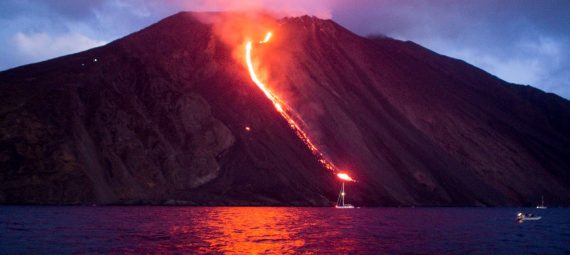
“Hot as Vesuvius”
Lava, ash and earthquakes are not attributes of the distant past of our planet. There are still places in the world where all this is perceived as the most mundane things. For example, the “lighthouse of the Mediterranean Sea”, the island-volcano Stromboli, located off the northern coast of Sicily, does not cease to play pranks throughout its turbulent history: every day it throws out a portion of stones and boiling lava, which flows down its slopes to the coast and, hissing, evaporates seawater in lagoons. The best way to observe the activity of Stromboli is to go by sea to its shore (not too close, of course, so as not to get slapped by a red—hot stone) at dusk, when the wonders of natural pyrotechnics are especially clearly visible.