
 Science
Content:
An event that takes place every 8 years Will Venus
really join the Pleiades?
How do you find Venus and the Pleiades in the night sky?
The Pleiades are an unusual star cluster
Interesting facts about the
Pleiades in religion and myths
An event that takes place every 8 years
What do you think is the brightest object in the sky after the Sun and Moon? It's called the Morning Star, but it's actually not a star, but our neighbor, the planet Venus. It is 1.5 times closer to the Sun, and slightly smaller than Earth.
On April 2, 3 and 4, 2020, while admiring the night sky, you will be able to observe a unique phenomenon — the merger of Venus with one of the most beautiful and mysterious star clusters, the Pleiades (also known as the Pleiades) — M45). You only get a chance to watch such a spectacle once every 8 years. It will also be possible to admire this phenomenon without a telescope — Venus is so bright that sometimes its light even breaks through the clouds. The Pleiades are inferior to her in brightness, but the light of Venus makes them extremely beautiful. Arm yourself with a camera with a good lens and you can take unique shots. Seize the moment — the previous connection took place in 2012, and the next one will have to wait until 2028.
© Photo Images/Canva
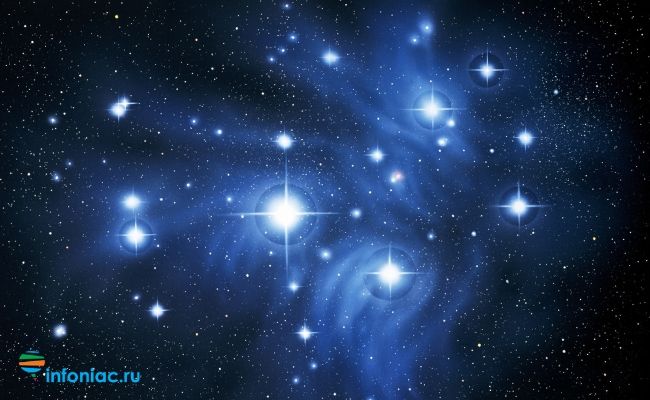
On April 3, in the evening, as we approach each other, Venus will be right on the Pleiades star cluster, just below Alcyon, the brightest star in the cluster.
Although Venus passes near the Pleiades every year, the planet merges with the star cluster only every second leap year. This year, the situation is extremely successful — Venus is now at the maximum distance from the Sun, making the combination of stars especially clearly visible in the night sky. You will find a link to the source at the end of the article, in the “Sources of Information” section.
Will Venus really connect with the Pleiades?
Venus is the brightest star in the sky. Although the Pleiades are also very bright, it will be difficult to lose the Morning Star among them. However, Venus appears brighter only from the point of view of an earthly observer. In fact, the Pleiades are giant stars that are much larger and brighter than our Sun, and Venus is very tiny in comparison with them (as is our Earth). And, of course, Venus's approach to the Pleiades takes place only from the point of view of an observer from Earth. In fact, the distance from the Sun to the M45 cluster is hundreds of light years, and Venus's orbit is only 200 million km in diameter (light travels this distance in 11 minutes).
Also read: 10 astronomical events you should not miss in 2020
How do you find Venus and the Pleiades in the night sky?
© John Chumack/Blogspot
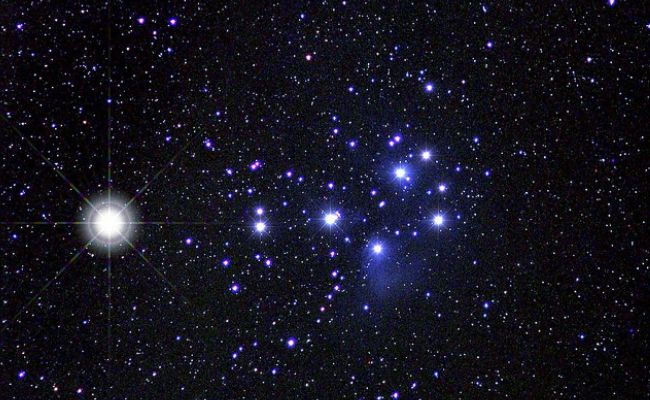
On April 2, 3, or 4, after sunset and dusk, find the brightest star in the western part of the sky. This is Venus. If you can use the clouds, you can't overlook it or confuse it with another star — it's always brighter than the rest of the stars.
Next to Venus, you'll notice a group of bright stars. If you can use the city lights, you'll notice that these stars are surrounded by a nebula. The Pleiades cluster resembles a swallow in shape.
Advice! It is best to watch the night sky away from the city lights, ideally in complete darkness.
Venus will be just below the Pleiades on April 2, surrounded by them on April 3, and slightly above the Pleiades on April 4. Accordingly, the merger will peak on April 3.
Read also: 2020 astrological forecast: planetary hints, tips and important events
Pleiades — an unusual star cluster
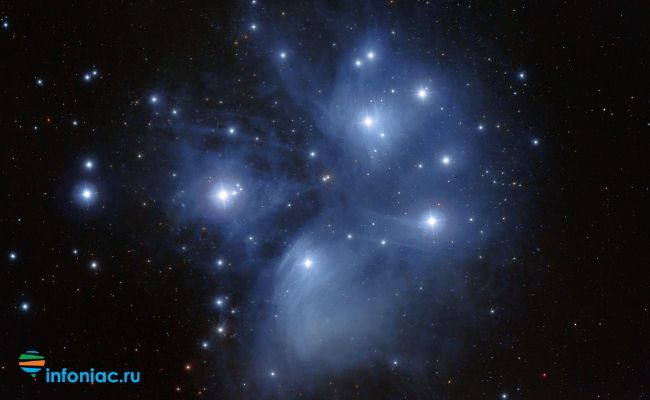
The Pleiades are a very dense cluster of stars in our galaxy, located in the constellation Taurus. Only 12 light-years in diameter, it contains about 3,000 stars. This is a kind of cosmic metropolis, and it is very densely populated. Compared to the Pleiades, you and I live in a small three-house space village: the closest star to the Sun, Alpha Centauri, is 4.4 light years away.
© Getty Images/Canva
For reference: a light year is the distance that a ray of light travels in one Earth year.
Although there are a lot of stars in the Pleiades, most of them are small in size, so to the Earth observer they look like fog, with the largest stars in the cluster visible count 14 (without using a telescope).
By cosmic standards, the Pleiades are a very young cluster: stars are no more than 150 million years old (for comparison, the Sun is about 4.5 billion years old). Accordingly, most of the stars in the M45 cluster were formed during the time of dinosaurs.
Interesting facts about the Pleiades
© Getty Images/Canva
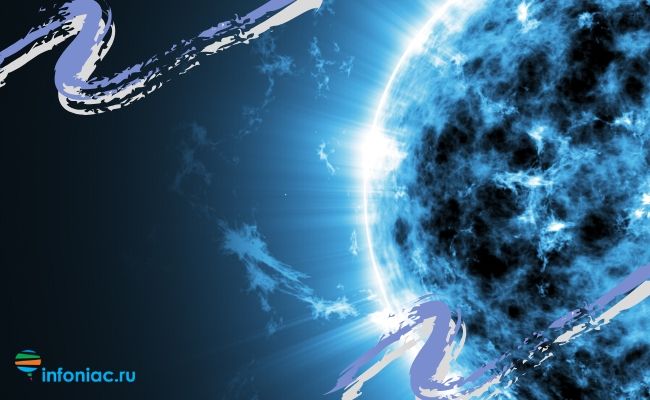
The Pleiades cluster is 350 to 450 light years away from us.
The brightest of these, Alcyona, is actually a system of four stars orbiting a common center of mass. The largest of these, Alciona A, is a blue-white giant six times more massive than our Sun, and much hotter.
An interesting fact! In fact, our solar system is not a common occurrence in the universe. Star systems consisting of two or more stars orbiting each other are much more common.
Another Pleiade, a star called Atlas A, is only 5 times heavier than the Sun and produces almost 1,000 times more heat. But this is not the limit: Elektra, being 5 times heavier than the Sun, emits 1225 times more energy. Can you imagine what would happen to the Earth if such a star appeared in the place of the Sun? In a few seconds, there would be no memories of life on Earth! It is so good that our Sun gives us “just a little bit” of warmth in a miserly way.
An interesting fact! Compared to the largest stars in the Pleiades, the Sun's heat transfer is simply negligible. However, this is why the Sun has been around for 4.5 billion years, and will last just as long. In turn, the ultra-hot blue giants of the Pleiades will survive for several tens of millions of years and, having quickly used up all their hydrogen, will die, becoming white dwarfs. Perhaps our distant descendants will witness the extinction of these beautiful stars.
Read also: Vampire Stars are changing our understanding of the universe
Pleiades in religion and myths
© Everett Collection, Inc./Canva
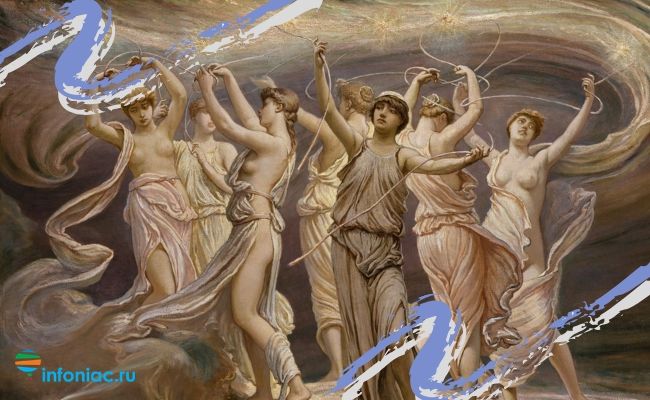
The star cluster was named after seven nymph sisters, daughters of the titan Atlanta, who holds the sky on his shoulders. According to an ancient Greek myth, Atlas asked Zeus to save his daughters from Orion, the hunter who was chasing them. Zeus turned the Pleiades into a group of stars, and Orion, as punishment for audacity, turned it into the constellation Orion (which, by the way, is near the Pleiades).
In the early 2000s, the so-called “Disc of Nebra” was discovered in Germany, a unique ancient bronze disc (3.7 thousand years old) on which the Sun, Moon, Pleiades and others are laid out in gold stars. It is believed that it served as an astronomical instrument and possibly a religious object.
Pleiades are mentioned three times in the Bible.
The Arabs called the brightest star of the Pleiades, Alciona, the “middle sun”, and believed that the whole world revolved around it.
The Mayan Indians counted the beginning of the new year from the time the Pleiades appeared in the sky (they appear in the Northern Hemisphere in March).
The name of the automobile manufacturer Subaru is translated from Japanese as “Pleiades”. The logo of the eponymous car symbolically depicts the six brightest stars of the Pleiades.
Astrologers say that the combination of Venus with Alciona (the Pleiades's brightest star) favors solitude. Accordingly, it is useful to spend April 2, 3 and 4 alone with yourself.