
 Incredible facts
A new study has shown that death in living things, including humans, spreads like a wave from cell to cell until the entire body dies.
This discovery may help scientists stop the biochemical process that leads to this wave of death and revive a person.
Processes such as death are quite difficult to study in animals. Plus, hardly anyone would want to participate in a study that would end in death. For this reason, scientists have studied worms whose mechanisms are very similar to those found in humans.
Another distinctive feature of worms is the fact that when they die, the spread of death through the body can be seen under optical magnification. It looks like fluorescent blue light caused by necrosis or cell death. This in turn depends on the calcium signaling system. The source of the blue hue is a molecule called anthranilic acid.
The process of death
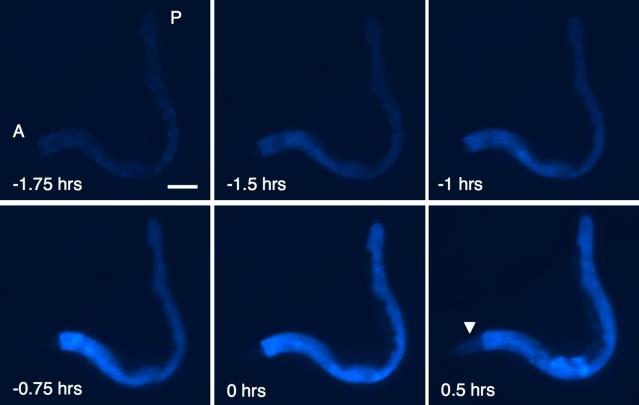
“We have identified a chemical pathway of self-destruction that spreads cell death in worms, as can be seen by the blue glow passing through the body,” explained study author David Gems from the Institute for Healthy Ageing at University College London.
The whole body does not die instantly. The death of individual cells triggers a chemical reaction that leads to the breakdown of cellular components and the accumulation of molecular “garbage”. If this is not prevented, a person dies.
The same type of damage can occur much more slowly as a person ages.
At the moment, scientists are unable to revive every cell in the body once it has failed.
But as a study on worms has shown, it is possible to prevent biochemical signals that spread death under other conditions.
10 body functions that continue to work after death
“We found that when we blocked this process, we were able to delay deaths caused by stress, such as infection. However, we have not been able to slow down the process of dying from old age,” James explained. “This suggests that aging leads to death through a number of processes that take place in parallel.”
Signs of imminent death
No one can predict the moment of death. However, doctors and nurses who care for the dying are familiar with certain symptoms that are related to the cessation of life in the body.
These signs are characteristic of the natural process of dying, and not all of them occur in every person.

– Loss of appetite
A person may begin to refuse to eat and drink, and take only small amounts of light food. By the end of life, a dying person may not be able to swallow food.
– Excessive tiredness and drowsiness
A person can start sleeping most of the day and night, and slowing down metabolism and avoiding food and water contributes to dehydration. It can be difficult for him to wake up, and he is very tired.
– Severe physical weakness
Lack of energy makes it difficult to perform even simple physical tasks, such as lifting your head and moving around in bed.
Scientists have explained what happens to a person's soul after death
– Confusion or disorientation
As organs begin to fail, awareness begins to weaken too. A person may not understand where he is, what time it is, rarely answer or speak.
– Difficulty breathing
Breathing in and out becomes irregular and difficult. You can hear Cheyne-Stokes's characteristic breathing: loud deep breathing is followed by a pause or cessation of breathing for 5 seconds to 1 minute, and then loud deep breathing returns.
– Social exclusion
A dying person may gradually lose interest in loved ones, stop talking and answering questions, or simply start moving away.
Other physical signs may include infrequent urination, low blood pressure, swollen feet and ankles, and cooling of the fingertips and toes.