
 Ecology
Glaciers and ice shelves around the world are melting at an unprecedented rate, but new data suggest that this phenomenon is uneven. As it turns out, some areas of the Himalayan mountain range are melting faster than others, and some don't seem to melt at all, scientists say.
The glaciers of the Karakorum mountain range remain stable and even slightly increase in size, as shown by studies published in the journal Nature Geoscience.
“Most of the glaciers in the Himalayas are melting, but the part adjacent to the Himalayas in the northeast remains intact,” says Julie Gardelle from the University of Grenoble, France. “This is very unusual glacier behavior.”
Karakorum Mountains
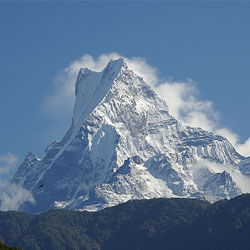
The Karakorum mountain range (pictured) stretches along the Indo-Chinese-Pakistani border. It is home to the second highest mountain on the planet, Chogori, as well as the densest cluster of very high mountains with a height of about 8,000 meters. These mountains store about half the volume of all Himalayan glaciers.
The Himalayan high mountain range is 2,900 kilometers long along the border between India and Tibet. It began to form between 40 and 50 million years ago, when two land masses, Indian and Eurasian, collided together. Since the two plates had approximately the same density, the only way to withstand the pressure from the collision is to rush up, so very much formed at the boundary of these two plates high jagged mountains – the Himalayas.
Scientists used satellite images to analyze the amount of ice in an area of about 5,615 square kilometers. The images were taken by the satellite in 1999 and 2008. The researchers used two computer models to decode these images. As a result, they found that the glaciers rose slightly and the amount of ice in them increased.
Despite this situation, Gardell warned that this does not mean that global warming is not affecting glaciers elsewhere. She said warming could cause more rainfall at higher latitudes, which could thicken the ice layer in some areas.
Glacier growth
Glaciers grow or shrink depending on the amount of snow and temperature levels. It is still a mystery to scientists why glaciers in this area of the Himalayas do not melt. This may be due to heavy snowfalls, but so far this data has not been verified.
It is very difficult to study glaciers in this region due to the location and physical characteristics of the Karakorum Mountains. Usually, studying satellite images is combined with work on the ground, so in the future, scientists are going to go to the mountains to confirm the conclusions made after analyzing the images.
According to earlier estimates, due to the melting of Himalayan glaciers, sea levels rise by 0.04 millimeters per year. These figures should be changed to take into account the anomaly of the Karakorum mountain system. Scientists suggest that Himalayan glaciers can raise sea levels by only 0.006 millimeters per year today.