
 Technologies
For supercomputers, not only power is important, but also energy consumption, which has become one of the biggest technical problems for fast computers.
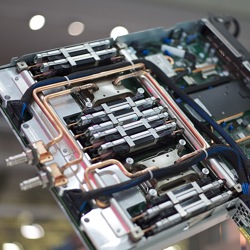
The Leibniz Supercomputing Center, Germany, has announced that their SuperMUC supercomputer, built in collaboration with IBM, uses 40 percent less power than comparable machines. And the thing is that a significant reduction in energy consumption was achieved due to water cooling. This IBM approach will make it possible to build relatively compact supercomputers.
In computer water cooling systems, water circulates through active components such as the processor and memory. Often these cooling systems must lower the temperature of the incoming water before circulating. However, SuperMUC can work with hot water heated to 40 degrees. At the same time, the hot liquid can later be supplied through heating pipes, where it is used to keep the building warm in the winter. The Center estimates that this will save about one million euros each year.
For all its energy efficiency, SuperMUC is the fastest computer in Europe with a peak performance of three petaflops. The computer is equipped with more than 150,000 computing cores in 9,400 computing nodes and more than 300 terabytes of RAM.
The computer cooling technology is called Aquasar. Water flows through microchannels directly to the surface of server processors.
Computer water cooling has been around for several years. Methods for managing energy consumption at maximum power are becoming increasingly important – developers are striving to assemble increasingly powerful computers in small spaces. Thanks to its energy-saving design, SuperMUC is ten times more compact and much more efficient than systems of similar power, but air-cooled, according to Leibniz Supercomputing Center.
IBM believes that the use of heated water for cooling will play a central role in future supercomputers, including the architecture of three-dimensional chips in which several processors are stacked together on a friend. The company's researchers are working on creating a tiny tube with a diameter of just 50 microns. With water cooling, IBM predicts that by 2025, the supercomputer could fit into a 2012 desktop case.