
 Ecology
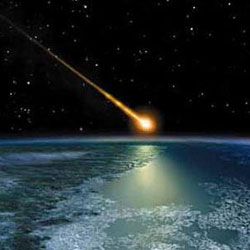
An international team of scientists has discovered fused glass in terrestrial rocks, which is about 13,000 years old, formed at temperatures between 1700 and 2200 degrees Celsius. Such material could only be formed if a space object fell to the surface of our planet.
The discovery was made by a team of 18 scientists, including James Kennett, a professor of earth science at UC Santa Barbara.
Found in a thin layer of sedimentary rock in South Carolina and Syria, the material provides the latest evidence supporting the “Late Dryas Collision” hypothesis, which states that it is about 12,900 years old ago, due to the collision of the Earth with a space object, an unusually cold period began on the planet, which was called the Late Dryas.
This event took place around the same time as the mass extinction of North America's megafauna, and mammoths, giant sloths and other animals became extinct. Also, as reported in the journal Proceedings of the National Academy of Sciences, during this period, the Clovis culture, a North American aboriginal culture that was quite widespread on the continent, disappeared .
Flint, rubbish smelting materials have been found on two different continents, with both sites dated to roughly the same time, the researchers said. These materials were formed due to a strong impact on the Earth's surface by a space object. The clash marked the beginning of the Late Dryas period. This period was not easy in the history of mankind, flora and fauna due to the climate changes that were observed at this time.
The study of the material showed that it is neither cosmic nor volcanic in origin, and that it was not formed due to human activity. This kind of material could only be formed when a space object, such as a meteorite that collided with Earth, formed the Arizona crater.
This melted and solidified material is similar to that produced by the 1945 Trinity nuclear bomb tests in Socorro, New Mexico. The formation of this material requires very high temperatures, which were observed during the explosion of the atomic bomb and which were sufficient to melt sand.