
 Ecology
Tiny pores in plant leaves, whose purpose is still vaguely understood, are an integral part of making accurate climate change forecasts. A new study suggests that they, the microscopic pores of plant leaves, react to sunlight, that are the most important universal link between plants and climate.
Understanding this connection can significantly improve the system for constructing weather and climate forecasts in general, because it is possible to accurately determine atmospheric changes in regions where plants predominate, that is in forests, meadows, etc.
“If all the plants in the world were to be destroyed, the earth would be much hotter and drier,” explained Joseph Berry, a Stanford University specialist. This is because plants evaporate water through these pores, called stomata, in response to how much sunlight falls on them, how photosynthesis is going on and how much carbon dioxide contained in the air.
Shaping future climate models
Over the years, climate models have been compiled based on information about plants collected by Berry and others and the moisture they evaporate. These data were used, for example, to prove that large amounts of carbon dioxide in the air clog stomata, which reduces the volume of evaporated water, and therefore, fluid inflows increase, because plants begin to consume less water from the soil.
The problem is that previously data on plants were obtained only on the basis of a few types and were not analyzed at the level of a deep understanding of how plants, or rather their stomata, react to changes in the amount of light, heat and carbon dioxide. “We needed more information about stomata behavior because empirical evidence about plant activity was scarce,” says Berry.
Thus, he and his colleagues conducted a thorough laboratory study of how the stomata, and therefore the water balance within leaves, react to the light they absorb. As a result, they came to the conclusion that stomata are not just pores in leaves; they are also solar energy sensors that monitor the rate of transpiration in leaves.
The process of photosynthesis
These data contradict current ideas about how stomata affect transpiration, because it has long been believed that photosynthesis is due to the amount of light present. In fact, the process is much more complicated and subtle. “The closing cells on which stomata work receive information from leaves,” Berry continues.
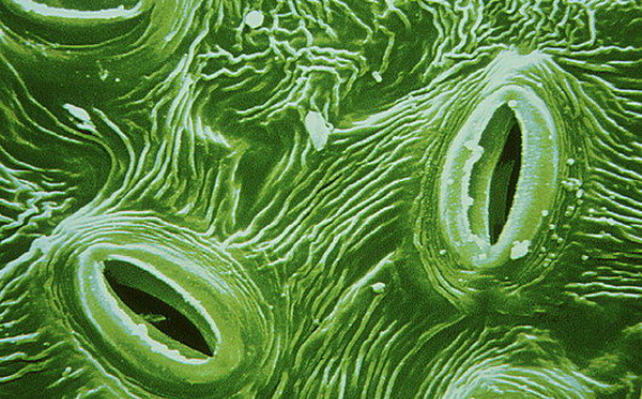
Stomata appear to collect information and respond to signals received not only from sunlight, but also from carbon dioxide and other important changes in leaves. “This is the starting point from which to make correct forecasts, because only such forecasts will help us better understand what is happening in reality.”
However, it is impossible to obtain complete information even from stomata, because there are processes such as drought and a high concentration of carbon dioxide in the air. The behavior of stomata in all plants is quite stable, because stomata that existed many millions of years ago look similar to modern stomata.