
 Science
Scientists who are keen to learn more about methods for discovering new families of planets should pay attention to Pluto and its moon Charon.
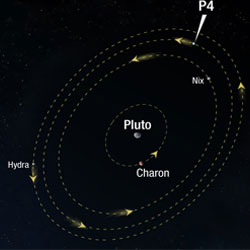
The ice couple, which is 40 times farther from the Sun than Earth, orbits in the company of three more “moons” — Nikta, Hydra, and the newly discovered P4 object, which orbits the planet between the first two.
The entire satellite system takes up less space than the distance between the Earth and the Moon, which allows scientists to assume that similar systems may be found outside our system around double stars.
After discovering P4 using images taken by the Hubble Space Telescope, astronomers created computer models to accurately locate the satellites relative to each other, Pluto and Charon. Charon is a relatively large object that makes up 12 percent of Pluto's mass.
“I was very surprised to find another satellite between the other two. This means that other satellites are influencing it,” says Andrew Youdin, an astronomer at the Harvard-Smithsonian Center for Astrophysics. He added that this could happen to planets outside the solar system.
Yudin and his colleagues were not only able to determine the maximum size of Pluto's moons and where they are located. Research has helped scientists determine where to look for planets that could orbit two native stars. For example, researchers using the Kepler space telescope discovered a system with a single planet that orbits two stars at once, but there were not several planets, according to scientists. It is now clear to them that they can revise their theories.
“By studying Pluto, we've learned how far satellites must be at a certain mass to rotate for millions or even billions of years,” Yudin said.
Computer simulations will soon be supplemented by tests in flight conditions. NASA's New Horizons Interplanetary Station is on its way to the edge of the solar system to study Pluto, Charon and other smaller satellites, as well as other Kuiper Belt objects.
“In a few years, we'll know if we were right or wrong,” said Yudin. “You can study satellite motions using Hubble images, but the data will not be as accurate as the data that a spacecraft can do if it's in this area.”
Geometry prevents any other satellites from getting close to Pluto, but other objects can orbit around it, but much farther than others. Scientists fear that the ship may be damaged by such objects. Even if something the size of a grain hits the ship, it could fall apart.
Hubble will be set up to search for potentially dangerous areas until the ship gets closer to the target and can turn on its own cameras. The team of astronomers is also developing another flight route to Pluto if the first one fails.