
 Events
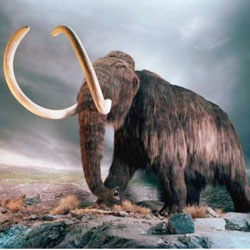
The discovery of a well-preserved young woolly mammoth makes it clear that ancient people “took” mammoths away from hunting lions, researchers say. Bernard Buigues from the Mammuthus organization found a mammoth frozen in the permafrost of Siberia.
Scientists completed an initial study of the animal, which they named Yuka, in March this year. Wounds on the mammoth's body indicate that both humans and lions may have killed this beast.
“We already have evidence that a mammoth was fighting for life and death with some top predator, possibly a lion,” said mammoth expert Professor Daniel Fisher from the University of Michigan. “Even more interesting is that it was probably the man who “took” the prey from the lion.”
If further research confirms the initial analysis, this would be the first sign that ancient people who lived in these places thousands of years ago were involved in the killing of this beast.
After analyzing the mammoth's teeth and tusks, scientists determined that Yucca was about 2 and a half years old when he died. Teeth, tusks, and bones are parts of the body commonly studied by scientists who study extinct animals, as it takes a huge amount of time for them to fully decompose.
Soft tissues such as muscles, skin, and internal organs decompose much faster and can rarely survive on ancient skeletons. This suggests that very important information for scientists is usually lost in time.
However, most of Yucca's soft fabric, as well as the woolly skin, remained virtually intact and well preserved after lying in the ice grave for about 10,000 years.
Scientists have confirmed that making such a discovery is an incredible success; it is of great value for science. One of Yuki's amazing features is his reddish coat.
The possibility that mammoths had lighter coats was suggested in 2006 when scientists studied genes that were isolated only from animal bones. Yuka provided direct evidence that mammoths actually had light hair.
Some scientists say that the finding will be useful to researchers if it helps them find a link between phenotype (the characteristics of an individual that we can see) and genotype (sequence) DNA).
This link will help scientists determine how common physical features, such as eye color and coat, are in mammoth populations, simply by studying genes taken from bones and hair in the future.
Professor Fisher agrees: “It's like someone handing you their diary, but you haven't been able to read it before.”
Lion attacks
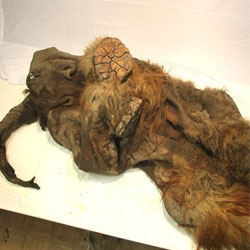 The healed scratches on the mammoth's body suggest that he could have escaped from the lions' sharp teeth a little earlier. However, deeper wounds, which did not heal, suggest that the lions attacked him again shortly before his death.
When Professor Fisher tried to move Yuki's leg, he found that the bone was broken shortly before his death, possibly when Yuka was trying to escape from being chased by a predator.
Lions that hunted mammoths are extinct subtypes of African lions (lat. Panthera leo spelea), known as cave lions, that lived at the same time as mammoths.
Scientists did not know for sure whether lions hunted mammoths, but the find confirms this. In modern Africa, young elephants suffer from lion attacks, and their injuries are very similar to what we can see in Yuki.
Lions usually reach the spine through the abdomen, they stick their teeth into the mouth and throat of their prey to try to strangle it, and they also chew on the elephant's muscular trunk. However, Yuki's trunk was not injured, only mild skin damage on her face was seen.
Strange injuries were also seen on the mammoth's body: a long straight incision that goes from the head to the center of the back, unusual cuts on the skin on the upper part of the right side.
The skull, spine, ribs and hip bone have been completely removed from Yuki's body, but the skull and pelvis were found close to the rest of the remains. Most of the spine and three-quarters of the ribs have disappeared.
Human intervention
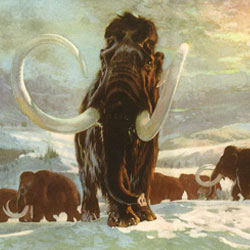 Each jagged mark on the skin is made with 15-30 small teeth that could be on an instrument used by a person. At first, scientists thought that those who discovered the mammoth in our time could have left these marks, but the researchers assure that they had nothing to do with this. Perhaps there is a connection between humans, mammoths and lions.
“Maybe people used lions to catch mammoths, and then took their prey,” scientists speculated based on what they saw. In support of this argument, it is worth saying that the Dorobo tribe from Kenya still practices this type of hunting, taking what they catch from lions.
What do we know about woolly mammoths?
— Woolly mammoth (lat. Mammuthus primigenius) evolved from hairless African elephants.
— It is believed that these animals became extinct about 3,700 years ago.
— They lived in the northern hemisphere and were forced to move north to Siberia and northern Europe when the Pleistocene Ice Age began to end about 15,000 years ago.
— The woolly mammoth had a thick fat layer about 10 centimeters wide and a dense coat that helped it escape from severe frosts.
— Small ears, short tails and a warm coat helped prevent heat loss.
— Mammoth trunks were about 5 meters long and were used for digging up food in deep snowdrifts, as well as for defense.