
 Ecology
A series of photographs from 80 years ago, which were discovered in a basement archive, point to the marked sensitivity of Greenland's glaciers to climate change, according to new research.
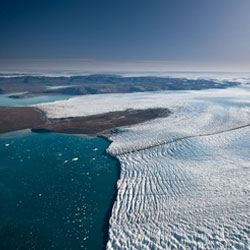
The study, which was published on the website of the journal Nature Geoscience, showed an example of uneven ice melting off the southeastern coast of Greenland. Aerial images dating back to the 1930s show a period of glacier retreat between 1933 and 1943, followed by a period of glacier onset that lasted until 1972. Not so long ago, this ice collected in the middle of the 20th century was lost due to global warming.
“Comparing these photos with more recent ones, you can see that the mid-century cold snap stabilized the glaciers,” says Jason Box, a geographer at the Polar Research Center Baird at Ohio State University. “If we want to stabilize the ice that is melting at high speed, there is no choice but to wait for a cold snap.”
Long considered lost, the photographs were taken during an expedition led by Danish explorer Knud Rasmussen. The images taken from the plane show land, sea and ice in the southeastern part of the island. After the expedition, the researchers made a map from the photographs they had taken. The pictures were hidden by the Danish Real Estate Registry and were forgotten.
Researchers were rummaging through the basement of the archive for a long time when they came across interesting photos. They contacted the Natural History Museum of Denmark, where they realized that the images were of great value to science. Satellites only began monitoring Greenland's glaciers from space in the 1970s, and measurements had been very rare before. The images helped to understand the sensitivity of ice to temperature changes.
Dr. Anders A. Anders A. Bjørk and his colleagues digitized photographs using computer programs and compared them with photographs taken during World War II by the US military, as well as with modern satellite images and photos from the aircraft.
It was found that the period between 1933 and 1943 was unusually warm in Arctic history. Between 1919 and 1932, average temperatures in the area rose by 2 degrees per decade. This is half a degree less than it is today.
Between 1933 and 1943, glaciers went 10-50 meters per year, as the photos show. The glaciers that were on the island disappeared even faster than those that went to sea. Currently, glaciers are melting, which began in 2000, and the ice that covers part of the ocean is melting much faster than those under which the land extends.
Today, southeastern Greenland's glaciers are disappearing at a rate of about 50 meters per year, faster than in the 1930s. Some of them are melting even faster: one glacier, for example, is losing about 887 meters of ice per year.
Cold period
Between these periods of warming, Greenland's glaciers managed to collect an impressive amount of ice. There was a cold snap between 1943 and 1972. About 60 percent of Greenland's glaciers have gained weight, and 12 percent have remained stable.
It is likely that the cooling was partly caused by natural atmospheric cycles, partly by atmospheric pollution with sulfur dioxide. Sulfur dioxide is an industrial pollutant that is the main culprit for acid rain; it has a detrimental effect on human health, but it also reflects the sun's rays from the Earth. Sulphur dioxide levels in the atmosphere decreased after the Clean Air Act in 1963.
Glaciers respond to warming and cooling faster than previous studies have suggested. They are very sensitive to changes in both air and water temperature.
Warming in recent decades has destroyed much of the ice that was accumulated during the cooler period before. The fact that the ice that covers part of the oceans is melting is a serious problem, as it raises sea levels the most. Although the last period of glacier melting is more serious than the 1930s, their patterns are very similar. Recent images show that Greenland's glaciers are melting 30 percent faster than they were 10 years ago.