
 Ecology
For many whales and dolphins, the world is shaped by sounds. With the help of echoes, they hunt and navigate in space. Navigation in this case requires super sensitive hearing. Scientists have recently discovered that some whales are able to tune their hearing.
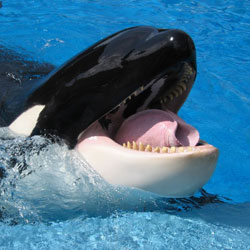
Scientists from Hawaii studied the hearing capabilities of a female killer whale and found that she can fine-tune her most important sense – hearing. The killer whale can “screw” audibility when it encounters very loud sounds.
Scientists led by Dr. Paul Nachtigall worked with a trained killer whale named Keena. They presented their research results at the Acoustics 2012 meeting in Hong Kong.
Nachtigall and his colleagues at the Russian Academy of Sciences first noticed five years ago that Keena has the ability to “control volume levels”. Scientists observed Kina's hearing while hunting.
Little orcas belong to a group of animals known as toothed whales, which also include dolphins, sperm whales and orcas. These marine mammals hunt by echolocation — they produce high-frequency clicking or buzzing sounds and listen to echoes that are reflected from objects in space, in this case from prey. Thus, they determine its location.
To understand Keane's hearing, scientists needed to understand what was going on inside her head.
“Her whole head is a big 'hearing aid, '” says Dr. Nachtigall. “Sound goes through many paths before it gets to the real ear.”
Scientists placed sensors combined with soft latex suction cups on Kina's body to measure the electrical activity of the animal's brain, which responds to sounds. “The louder the sounds, the bigger the brain waves,” says Nachtigall. “And if the killer whale doesn't hear sounds, then we won't see any vibrations.”
The researchers provided Keene with a “neutral tone” — a safe short signal followed by a 5-second vibration of 170 decibels. This sound is roughly equivalent to the sound of a rifle that shoots at a distance of 1 meter from the hearing person.
Over time, Keena realized that a neutral tone was like a warning signal before a louder sound, so she reduced her hearing sensitivity after hearing it. This was shown by sensors that recorded a weaker signal for the second time at the same volume.
Dr. Nachtigall explained that marine mammals that use echolocation have evolved such a rapidly adjusted hearing system to protect themselves from their own clicks and buzzing.
“The sounds they make are very loud — they can make 230 decibels, and then they need to hear very quiet echoes,” Nachtigall said.
Scientists believe their research will eventually help protect wild marine mammals. It is well known that whales and dolphins suffer from loud underwater noise caused by human activity, such as ship sonars or loud equipment that used in oil and gas production.
“We are very optimistic because many animals that use echolocation — dolphins and whales — will be able to protect themselves from these sounds by being warned,” Nachtigall said.