
Twenty years ago, my friend and I became interested in Buddhism.
In 2006, we decided to go to India. It was my first trip abroad and at the same time a pilgrimage: there are places sacred to Buddhists in India. For example, my friend and I visited Sarnath, a suburb of Varanasi, the site of the Buddha’s first sermon after enlightenment.
When we spent the night in an ashram — a Hindu monastery, we met a group of Muscovites. They also traveled to India more for pilgrimage than for tourist purposes. We exchanged contacts, and in winter one of them offered to go to Tibet with him and his friends. They needed a group of four people, and only three were recruited. This place was my dream, and I reasoned that such a chance does not come often.
Before that, I thought that a trip to Tibet was unrealistic, I couldn’t afford it, and in general, such things happen to other people, cooler and more successful than me. It turned out that a trip to Tibet can be carried out by a person with average incomes and not enlightened at all.
In those years, paranoia, dementia and courage were combined in my character: I was afraid to return home late at night, but at the same time I hitchhiked in Siberia. And so in September 2007, we went to Tibet with a group of strangers. It didn’t bother me that I saw the person who offered me the trip once, and I met his friends from Moscow — a girl of about 25 and a man of about 45 — only at the beginning of the trip.
15 years have passed since then, a lot has been forgotten, and I can get confused in minor details. But in general, I remembered the most striking moments, so I think that my unusual experience is worthy of a separate article even years later. That’s how it was.
SHOCK # 1
Nature
On the first day we drove a jeep through the Kathmandu Valley. Forests and rice fields crowded along the road. Closer to the border with Tibet, the road gradually turned into a serpentine. He wasn’t scared yet, the landscapes were still colored and green, and it was hot outside the window.
A couple of times we got out of the car to take a photo, for example from a suspension bridge.
Interestingly, the border between Nepal and Tibet practically coincides with the natural border between the foothills and the real mountains. The border between the countries itself turned out to be a mountain river thirty meters wide, which our Toyota Land Cruiser overcame without problems. Almost immediately after the transition, a real mountain serpentine began with very sharp turns and a strong climb.
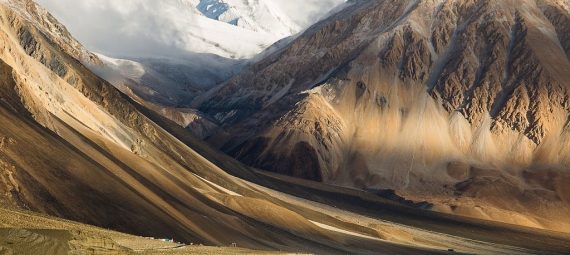
The views looked less and less like the green valleys of Nepal: more gray and brown shades, fewer colors, the mountains are noticeably higher. But it became more and more interesting to us — this is the real Tibet! I remember with what delight I photographed a small temple, which was perched on a steep slope and was barely visible from afar.
On the second day of the trip, the road turned into a very steep mountain serpentine. In some places there were concrete blocks to prevent cars from falling into the abyss. They were soothing. And rows of small columns with faded red and white colors caused hysterical laughter — they made it even scarier.
There are regular landslides in the mountains, and one of them happened that day. We waited for many hours until the blockage on the road was sorted out, then let oncoming cars pass, and then slowly moved in a huge traffic jam.
On the road, something that we had never seen floated by all the time — unreal landscapes with mountains and snow-capped peaks. It was the Himalayas. We did not look at Mount Everest: the view of it opens from another road.
We climbed one of the highest points of our journey — the La Lung La and Tong La passes. They are located side by side, about 11 km from each other, and are almost identical in height — 5124 and 5120 m. I never figured out where which one is, but I remember one of them. It was decorated as an arch over the road with a bunch of prayer flags.
We stood on the pass for 20-30 minutes. From there, there was a gorgeous view of the Himalayas — Shishabangma, the smallest of the eight-thousand-meter peaks, and several lower peaks. The mountains were huge and unreal, and I did not regret at all that I did not see the largest peak in the world — Everest.
Near the pass, we noticed strange structures made of several stones stacked on top of each other in the form of a pyramid. If a Tibetan is overcome by the spirit, he can build such a house and ask the spirit to go live there. We also saw larger structures made of stones — such stone anthills up to the waist. The stones were held together with cement and wrapped with polyethylene. Then I found out that these could be dedications to spirits and deities.
On the fifth day of the journey, we found ourselves on Lake Manasarovar, 33 kilometers from Mount Kailas. This is one of the highest located lakes in the world. It is called sacred. Hindus believe that when Brahma created the world, this lake was the first to appear in his mind. Buddhists believe that the Maya Queen conceived a Buddha in him.
SHOCK # 2
Mountain sickness
Mountain sickness overcame us almost all the way to Mount Kailas. Even when we landed in Kathmandu, I felt a heaviness and pain in my head. They passed by the evening of the next day.
The most terrible thing began on the way to Nyalam. The village is located at the level of 3800 m . The higher we climbed, the worse it became: shortness of breath, constant fatigue, headache. If we walked all the way, the climb would be gradual and would not affect the body so much. But when you drive a car, it turns out to be sharp. For example, the height difference between the place of our first Tibetan overnight stay — the village of Zhangmu and Nyalam, where we reached by the end of the second day, is 1300 m. For the lowlanders, this is a lot.
In our company, everyone suffered from altitude sickness in different ways. I was 25 years old at the time, the second girl was about the same age. The guy who invited me was about 30 years old, and the organizer of the trip was about 45. Perhaps it’s due to age, but he felt the worst of all for the rest of the trip.
The other girl and I had an average climb: at first it was bad for us, but gradually we adapted and on the way back we already enjoyed the views and impressions. The guy who invited me turned slightly sour even before Nyalam, but after a height of 3.5 km, he stopped feeling mountain sickness at all. He wasn’t even seasick.
Mountain sickness did not come as a surprise to us: we found out about her in advance, I even read about deaths. But it’s one thing to read, it’s another when you feel it all yourself.
SHOCK # 3
Bark
Followers of Buddhism, Judaism, Jainism and Bon religion practice ritual rounds around sacred places. In Tibetan it is called “kora”, and in Sanskrit it is called “parikrama”. Such a detour is most often done on foot, although on Kailas we saw people on yaks and local stunted horses.
Most often, the bark is made around a temple or monastery. It takes five to ten minutes. You can pass more than once, and 108 is a sacred number in Buddhism. But there are long detours — around a sacred lake or mountain, for example Kailas.
Buddhists believe that during the kora around Kailasa, you are freed from the sins accumulated over several incarnations. If you go through such a bark 108 times, you can achieve enlightenment or nirvana.
I didn’t have a goal to get rid of my sins. For me, Kailas was a magical mountain, a place of power. Even before the beginning of the bark, I bought a metal keychain with the main mantra of Tibetan Buddhism “Om mani padme hum”. Literally translated, it means “O pearl shining in the lotus flower!”. But for Buddhists, the meaning of the phrase is not so important. The main point is that the syllables and words of the mantra purify the mind and dissolve desires.
Walking around Kailas takes Europeans two and a half days. This is one of the longest and most difficult routes for the bark — 53 km through mountainous terrain, with steep ascents and a large climb. The difference between the start in the village of Darchen and the highest pass on the route is about 1100 m . It’s like climbing a house of 366 floors.
The Tibetans said they could cover this route in one day. For people who are not used to local conditions, this is unrealistic. Moreover, some pilgrims do not just walk the bark, but prostrate: they make a bow, kneel, stretch out completely on the ground, then get up, bow again and so go the whole way. I can’t imagine how long it might take. We have not met such people.
The bark around Mount Kailas is made by many pilgrims from different countries, but there are a minority of Europeans among them. It is interesting that Hindus, Buddhists and Jainists go around the mountain clockwise, and Bonets — against.
SHOCK #4
Climate
Tibet is located on the Tibetan plateau. This is the highest highlands in the world, its average height is 4000 m. There is a sharply continental climate with large daily temperature fluctuations.
At night, the temperature can drop below zero even in summer. In the morning, the puddle in the yard will be covered with a crust of ice. In winter, the temperature at high altitudes reaches -40 ° C. And there is also very clean, dry and thin air and very, very much sun. In practice, this means constant extreme discomfort.
We did the bark in September. This is how it looked on the first day.
You are walking with your little backpack, the road is always up, you are puffing and choking. And so go out into the sun. You immediately get hot, and the sun hurts your eyes, which is reflected from the snow. You take off your jacket, hat and gloves, untie the scarf and unbutton the jacket. Then you stay in one T-shirt and put on sunglasses. They must be worn constantly: not just with dark glasses, but with the maximum category of protection. It hurts to look at the snow shining under the sun, but the main problem is ultraviolet rays and infrared radiation. Sunlight in such quantities can even burn the cornea or retina.
Here you put on your glasses, and five minutes later a cloud comes up or you get into the shadow of a mountain. You can’t see anything else through the glasses, and it’s also getting very, very cold. You immediately pull all the clothes back on. At the same time, you are whining, because every movement is an additional effort, and it is not given as easily as on the plain. I remember my irritation when, on a short vacation, I reached into my backpack for warm trekking boots so as not to freeze in sneakers.
After ten minutes, the cloud leaves and everything starts again. And so ten times a day until you get bored. Then you just endure the heat and cold alternately. It is easier to stay warmly dressed, because even in the sun the air remains cold, sharp and unfriendly.
SHOCK No. 5
Religion
In Tibet, almost all space is associated with religion. Although the Chinese destroyed a lot in the middle of the 20th century, there are many monasteries and images of Buddhas and Bodhisattvas — beings who have achieved enlightenment.
In the morning on the second day of the way to Mount Kailas, we went to the local temple — the first one in Tibet that I have seen. He made a great impression on me, although I knew about what to expect: I had read about them, and there is a Buddhist datsan in St. Petersburg.
On the outer walls of the temple there were paintings on religious themes: the wheel of Samsara, images of bodhisattvas and defenders of the Buddha’s teachings. I felt a sacred thrill when I looked at them. For me, it was all alive and real.
SHOCK No. 6
Meal
On the first day of the trip, we went to taste the local cuisine and ordered various food in the cafe. We got a whole table with different strange dishes. The table was round and consisted of two parts. The upper one was spinning, and it was easy to move the right bowl to yourself.
I ventured to try black mushrooms, but they were tough. I didn ‘t eat eggs: they were ordinary chicken, only blue. I was scared off by the story that they are pickled for about a month almost in the ground.
There were also two types of rice with vegetables, soup with tomatoes and noodles. For visitors to Chinese restaurants, these are familiar dishes, but for me everything was new: I didn’t go to establishments then.
But the potatoes, as there, I have not seen anywhere else. They were small pieces, as if they had been cut on a grater. It seems that they are simply doused with boiling water or boiled for a very short time. They look like pasta and are very tasty. I remember how happy I was with potatoes — I love this vegetable. It was nice to see a clear, not spicy and not salty dish.
SHOCK # 7
The life of travelers
On the first day of the trip, when we stopped for the first night in the village of Zhangmu, everything was new to me.
Nepal was somewhat similar to India, even some kind of gingerbread compared to it. And here everything was strange: a dog that looked like a lapdog, but at the same time sitting on a chain. Slippers on the street at the door to the house.
Pilgrims spend the night in monasteries and guesthouses with terrible living conditions. Guesthouses are more like the lowest-grade flophouses you can imagine.
Usually these are rooms for a shared overnight stay with harsh beds. Sometimes they are old beds, and sometimes they are just boards that have been put on stone supports. They are covered with mattresses, and there is a space for sleeping side by side.
In some places there were bed linen, on which I did not dare to lie down. We climbed into sleeping bags and slept in our clothes.
SHOCK # 8
Hygiene
It seems to me that Tibetans don’t wash very often and don’t bother much with hygiene at all. Perhaps they don’t need it: the fierce local sun destroys pathogenic bacteria. But when you are brought up in a different environment, it is difficult to adapt to local habits in a week.
For example, on the way back we stopped for lunch. Beautiful local ladies treated us to cottage cheese. They squeezed it out of the bag right on dirty fingers. I couldn’t overcome my squeamishness and never tried cottage cheese from yak milk. In general, if you look at how something is cooked in Tibet, your appetite immediately disappears: they touch everything with their hands, crumple with their fingers. And the hands are dirty, and there is nowhere to wash them.
After the end of the bark, we did not immediately go back, but first went to wash at the hot springs near Lake Manasarovar. By that time we hadn’t washed for five days. We used wet wipes on the way, but I still felt dirty.
The washing room was arranged as follows: right above the hot springs there was a small building with separate rooms. There were baths. You open a rusty faucet — and please, hot water straight from the mountain. Now such bathing costs 50 CNY (425 P). In my opinion, 15 years ago it was cheaper, but I don’t remember how much.
It was magical after several days of traveling without a shower to finally splash in hot water. I didn’t even think about how clean this tub was. I think Nina is a little. The pleasure was marred only by the fact that the door was not locked, there was even a crack in it. Someone was walking along the corridor all the time, but there were no curtains on the bathtub. I hung up my things so as to block the view. But no one broke into my place.
After the bath, a fellow traveler said to me: “Oh, your face has even changed.”
SHOCK # 9
Animals
I am an ornithologist by education. I have not worked a day in my specialty, but I am interested in animals, especially birds. Despite feeling unwell due to altitude sickness, I looked at them joyfully.
Even when we were driving through the Kathmandu Valley, we saw small waterfalls along the road. My traveling companion even rinsed himself in one of them — it was hot and stuffy in the car. While he was enjoying the cool water, curious goats came to look at him. It was funny: they just stood next to each other and watched.
In Tibet, we saw yaks, local stunted horses and dogs from domestic animals. During the bark, I noticed that the dogs were walking as if by themselves, just for company. I didn’t see them guarding the yaks or performing any other tasks.
SHOCK No. 10
Pilgrims
Most of the travelers we talked to were very pleasant. There was a feeling of kinship with them.
The first such meeting happened on the border between Nepal and Tibet. We spent at least a couple of hours waiting for the transition. Mostly there were Nepalese, Chinese and Tibetans, and there were few people with Caucasian appearance. They looked at us curiously, and we sat and chatted. They considered themselves the only ones in this crowd who understood Russian.
Suddenly a man came up to us and spoke in perfect Russian. I think our slack jaws gave him a lot of pleasure. He was a German, a scientist, if I’m not mistaken — a philologist-Slavist. We talked for a while, and it was a great pleasure. His Russian was even better than ours — literary and polished. I immediately had confidence and sympathy for him.
The second strange encounter occurred when we were already near Mount Kailas. Officially, single tourists cannot get to Tibet. But we met a lonely young guy with a backpack and a cane — either from Belgium, or from Holland, I don’t remember exactly. It was as if he was walking from nowhere to nowhere. I still don’t understand what it was, where and from where he was going and how he got to Tibet alone.
During the first two days of the bark around Kailas, we were focused only on the route, but on the third day we had the strength to look at other pilgrims. Whoever walked with us: there were also Europeans, but mostly Indians and locals. Some were like characters from a movie: wrapped in shawls and skirts, dressed in strange colored robes, straw hats from the sun, with uncomfortable-looking trunks.
SHOCK # 11
Local residents
Tibetans are a Mongoloid race. They are mostly small, the men are not much taller than me with my 162 cm height. The Tibetans we met were guesthouse workers, monks, or were undergoing the kora, just like us.
Because of the racial difference, it was difficult for me to understand the age of those with whom we communicated. It turned out only roughly divided into children and adults, and then the gradations “like young” and “like old” began.
Some Tibetans were interested in us. Most often, children approached and tried to communicate. Occasionally they tried to sell something, but there was no compulsion.
One day we saw a family who came to wash clothes in a stream. It’s hard to imagine: I even try not to wash my hands at home, although I have hot water, and here is a stream with ice water. The only advantage is that the sun shines so hard that everything dries up instantly.
One of the children separated from his relatives, came up to us and sat down closer right on the ground. He sat for a long time and looked at us in silence.
Our guide and driver are the Tibetans with whom we communicated the most. They spoke good English, albeit with a strong accent. Most locals only know Tibetan. They were Buddhists, like most Tibetans. But from conversations with them, it seemed to me that they are more concerned with superstition than the philosophical content of religion. For example, they reported that they do not eat fish because Buddha once turned into it.
They were quite open to conversations, but at the same time there was a sense of distance. Now I regret that my poor English and shyness did not allow me to ask them more about local life. We hardly talked to the porters on the bark, and we didn’t have the strength.
There is a feeling that the Tibetans are so different from us that they do not even cause a sense of community. They live in completely different conditions, their culture and way of life are completely different, so it is difficult for us to understand each other.