
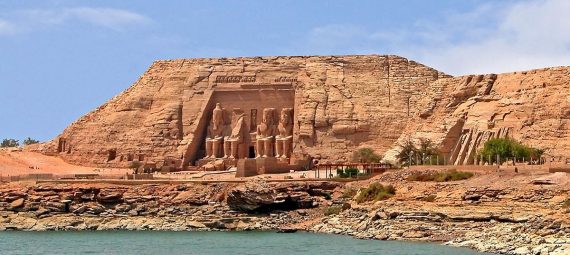
Abu Simbel is an Egyptian village near the border with Sudan. There is the temple of Ramesses II — in my opinion, the most majestic religious building of the Pharaonic era.
Not only the temple itself is impressive, but also the history. It was carved into a rock on the left bank of the Nile in the 13th century BC. Nearby is a temple in honor of Nefertari— the wife of Ramesses II. Both buildings were supposed to inspire awe and reverence to Egypt’s southern neighbors. In the Middle Ages, they were completely forgotten, they were covered with sand. In 1817, the entrance to the temple of Ramesses II was excavated by the Italian explorer Giovanni Belzoni.
In the 1960s, the complex was threatened with flooding due to the construction of the Aswan Dam on the Nile. Therefore, in 1964-1968, Unesco organized the transfer of monuments 60-65 meters above their original location. The temples were sawn into hundreds of blocks weighing 20-30 tons each and assembled as a constructor in a new place. A concrete dome was built above them, imitating a rock.
In Egypt, I visited Alexandria, Cairo, Luxor. Abu Simbel has always seemed desirable, but infinitely far from civilization. In addition, most of the year it is extremely hot there: from April to October, the temperature stays around +40 …45 °C. I decided to go on a trip in November 2022, when I lived in Hurghada.
There is no direct connection between Hurghada and Aswan, the nearest major city to Abu Simbel. I got from Hurghada by bus to Luxor in 4.5 hours and 320 LE. From Luxor to Aswan — by train in 72.8 LE and 3.5 hours. In Aswan, I rented a hotel apartment for three days for $ 123 . During the first two days I visited the sights of the city, for example, the well-preserved temple of Isis on the island of Agilkia and the quarries with a huge unfinished obelisk. On the third I went to Abu Simbel.
There are several options for how to overcome 280 kilometers between Aswan and Abu Simbel. The first is to hire a driver with a car for $ 115-135.. In the car, you can go a maximum of three. The second option is to go in a tourist minibus for 500 LE through a travel agency or for $ 25 if you book a trip through the owner of the hotel. The third is to go to the bus station in Aswan and buy a one—way ticket for 80 LE. The earliest flight is at 08:00.
I booked a trip through the owner of the hotel, as I did not want to waste time on trips to travel agencies and did not believe that the battered buses plying in the southern half of Egypt could arrive somewhere on time. The owner of the hotel also issued me a police permit to visit the border area. It is free, as I understand it, it is quickly given out by the police to everyone, but again I did not have extra time for this.
All tourist mini buses will start from Aswan at 04:00. I woke up at 03:00, by the scheduled time I swam across the river by boat. I lived on the island of Elephantine, and a free transfer was provided by the hotel. The minibus was delayed until 04:25. On a good road between Aswan and Abu Simbel, 280 kilometers can really be overcome in 3-3.5 hours. Actually, I was promised that I would be at the temples at 07:00. However, at the exit from Aswan, there was a traffic jam with tourists for an hour: the police were checking permits. And then, towards the end of the journey, the minibus stopped for half an hour at a cafe.
All the way we drove through the deserted Sahara along the artificial lake Nasser. The air conditioner was working inside, it was spacious — in general, a decent tourist minibus. We found ourselves at the entrance to the temple complex at 09:15. Usually drivers allocate an hour and a half to visit, but I, my girlfriend and an Egyptian friend easily persuaded them for 2 hours.
As it turned out, two hours was enough end-to-end. The complex is open from 06:00 to 17:00, the peak of attendance is at 08:00-11:00, before the midday heat. From 09:15 to 09:35 I was standing in queues — at the ticket office and to the ticket validators. The ticket office is occupied by tour guides with bundles of money, they buy a bunch of tickets for their customers. Mostly organized tourists are taken to Abu Simbel. We, independent travelers, have to wait, because the money is recalculated manually.
The ticket costs 275 LE — in my opinion, this is the most expensive attraction in Egypt. So, for a visit to the Valley of the Kings, you need to pay 260 LE, for the entrance to the plateau with the pyramids in Giza — 240 LE, to the Egyptian Museum, the citadel of Saladin in Cairo, the necropolis of Saqqara — 200 LE.
A sea of people was waiting for me at the entrance. It’s been a long time since I’ve seen such pandemonium in Egypt during the pandemic era. Long queues led to both temples.
At first I was horrified. All this went against the common romantic ideas about temples in Abu Simbel, where you feel at the edge of the world and take photos almost alone.
However, the horror quickly rolled back. The temple of Ramesses II is not called grandiose for nothing. On the sides of the entrance are four statues of a seated pharaoh. Their height is 20 meters, you feel like an ant next to them. The statues smell of eternity, like the Great Pyramids of Giza. For more than three thousand years they stood, sedate and undisturbed, except that one statue had its head split off due to an earthquake.
From afar, the structure seems solid. When you get closer, the cuts left by the workers still catch your eye. The transfer didn’t go so smoothly. Nevertheless, this does not spoil the overall picture at all and does not detract from the merits of Unesco. If it were not for the efforts of the international community, the monument would now be slowly being destroyed at the bottom of Lake Nasser.
Inside, the temple of Ramesses II has been preserved as well as outside. I knew that the interior spaces are small — all together they stretch 55-60 meters deep — so I was not disappointed at all.
The temple consists of a larger hall, a smaller hall and a tiny sanctuary with Ramesses the Second surrounded by the gods. In the main hall, eight 10-meter columns-statues of Pharaoh in the guise of the god Osiris-rest against the ceiling. The walls are decorated with reliefs telling about the military campaigns of the ruler. They are made at the same high level as in Luxor.
After the main building, I went to the Nefertari Temple. Six huge statues are carved on its facade: Four are Ramesses II, two are his wives Nefertari. Interestingly, the queen’s height is the same as that of the pharaoh. Usually, members of the royal family in ancient Egypt were depicted no higher than the knee of the pharaoh. Scientists believe that in this way Ramesses II reflected in eternity the love for his wife.
Inside the Nefertari temple, the columns decorated with the head of the goddess Hathor stuck in my memory the most. Time and vandals here have left almost no marks on the face of Hathor, unlike the temple of Hatshepsut in Luxor. I also remember that it is very stuffy in the Nefertari temple — the Egyptians need to do something with ventilation.
The two hours that I was in the complex, the temperature was +25…30 °C. Tolerable. I was wearing a hat and a short—sleeve shirt-I did without sunscreen. Next to the ticket office there is a bazaar, toilets and cafes, you can refresh yourself and take a break.
By 10:30, the crowds near the monuments thinned out, and at the beginning of the twelfth they completely dispersed. From which I conclude that ideally you need to throw in with friends, hire a driver and leave Aswan at seven o’clock. Yes, you will get into the midday sun, but without crowds. By the way, our minibus arrived much faster back — in 4 hours.