
We have provided life hacks on how and where you can admire the largest underwater predators in their natural habitat. And it will be absolutely safe for both people and animals. And no trips to oceanariums!
Cachalot
The sperm whale is the biggest predator on the planet. It was about him that Melville wrote in Moby Dick. Indeed, in elderly sperm whales, as in humans, pigmented white spots may appear in old age. The “elderly” giant male may appear white –Melville wasn’t lying.
The sperm whale is absolutely safe for humans in the water, and even more so in a boat. He feeds mainly on giant squid – he is not interested in people. This predator has a certain “bad” reputation due to the fact that sperm whales tend to stay in groups and they have a strong emotional attachment. If one of the group members is injured or in danger, then everyone else will protect him. That is why in the days of whalers (sperm whales are one of the most valuable whales because of the large amount of spermaceti) there were cases when sperm whales attacked boats. Being under attack, the whole flock surrounds the protected, forming a daisy formation (daisy shape).
But sperm whales are surprisingly intelligent animals. Recently there was a case when a sperm whale got a fish hook stuck in its tongue – and then it swam up to the freediver and opened its mouth.
Meeting with a sperm whale in the open ocean will not harm either an animal or a person. But one of the most vivid impressions in life will bring. Swimming in open water next to a 20-meter sea giant is something. But the most memorable feeling is the sonar of a sperm whale. Sperm whales feed on deep – sea squid at depths of about 1 km . There is no light there, so sperm whales have natural sonar.
So, if a diver is interested in an animal, and a sperm whale wants to look at a person better, then it turns its muzzle to him (since its sonar is very focused) and starts clicking, that is, making such a peculiar sound. The greater the interest of the sperm whale, the more often it clicks. These clicks are very strong – you don’t just hear them, but feel them with your whole skin and even with your body.
Where to go?
Sperm whales are distributed throughout the world’s oceans. The difficulty is that:
– they spend most of their lives underwater;
– they live only at great depths, where squid live.
So there is little chance to meet sperm whales near the shore. Only on islands of volcanic origin or near tectonic faults. For example, in the Azores and Sri Lanka.
Sperm whales sometimes sleep like floats (unlike other whales). At such moments, you can swim very close to them and hang around.
Killer Whale
The killer whale is a super predator, the most perfect and the most intelligent in the ocean. “Killer whale” – although the name actually comes from “killer whale”. Killer whales have the most complex social structure within the family, and also the most complex and sophisticated ways of hunting.
Killer whales transmit knowledge about life from parents to children. Although in fact, grandmothers teach everyone: they can no longer give birth and are not so cheerful for hunting, so they are engaged in raising grandchildren.
Many people consider sharks to be the main predators of the ocean, but in fact, killer whales are the main ones here. They can easily kill even great white sharks. The latter do not have gill covers (this is what fish move to filter water), so sharks need to swim constantly. And if a shark is turned upside down, it falls into a stupor. Killer whales know about this, so they grab the shark, turn it upside down and stand still until the shark suffocates. No wonder sharks are afraid of killer whales. San Francisco has an island where seals live. Both white sharks and killer whales come there for “lunch”. So, as soon as the killer whales come, the sharks from there immediately quickly dump.
It is absolutely safe for a person to be near a killer whale if it is wildlife, and not a dolphinarium. There are no cases of killer whales attacking humans in the wild. Each family of killer whales has its own diet: someone eats fish, someone seals, someone whales. They don’t consider anything else as food. In dolphinariums, animals often go crazy (they “get wild” from the way a person treats them), so there have been cases of attacks.
Where to go?
Killer whales are found everywhere, but it is quite difficult to find them: the fact is that everyone is afraid of killer whales, and therefore they behave very quietly. Norway is the best place to observe these predators – there are fish-eating killer whales and good water transparency.
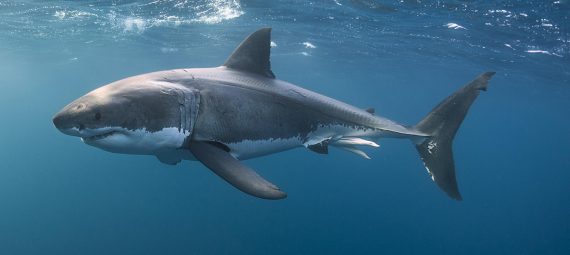
Great White Shark
An ancient super predator. Probably, it is the great white that scares people the most because of the movie “Jaws”, after which a real hunt began for these predators. By the way, Steven Spielberg has already stated that he is very sorry that he made this movie.
It’s definitely dangerous to swim with great white sharks. Although they very rarely attack people, but if this happens, the consequences for a person are serious. This predator is very effective – a perfect killing machine.
In principle, a shark is not interested in a man, since he is skinny and not nutritious. As a rule, attacks occur in two cases. First: one of the strategies of the white shark attack is to sit at a depth and watch the shadow of the seal on the surface. The surfboard resembles the shadow of a cat. The shark flies out, grabs. Realizing that this is not a cat, he spits out and leaves, but the surfer may be left without a leg or head. Second: if there is blood, then sharks fall into an excited state. And obeying instincts (since this is an ancient predator, unlike killer whales, their instincts dominate), the white shark grabs everything that moves.
And yet it is possible to swim with a great white shark in the open ocean – in a cage. Only there is a person in it, not a predator (ironic, isn’t it?). This type of entertainment is called shark diving and is very popular among fans of tickling their nerves and just wanting to meet face to face with one of the most dangerous predators on the planet. Despite the big name, you don’t need to be a diver for such a swim – no certificate, no equipment, no special skills are required. Sharks swim on the surface, attracted by blood (it is poured into the water in advance) and fish hanging nearby. All a person needs is to get down into a cage that is attached to the side of the boat and look at the sharks through a mask. It is absolutely safe, but there is a lot of adrenaline.
Where to go?
In South Africa – there is a Gansbaai Bay near Cape Town.
Blue Whale
The blue whale is the largest animal on earth – 35 meters and more than 160 tons. Such a living submarine. Blue whales are usually very economical, because at this size, each movement spends a huge amount of energy. So don’t think that whales will play with you or even pay attention to a person in the water. The whale will just keep swimming along its route.
Despite its size, a meeting with a blue whale is completely safe for a person. He just doesn’t pay attention to such little things as people. They even open their mouths at all times if the flock of krill encountered on the way is not large enough (more energy will be spent on swallowing it than will be obtained from food).
And anyway, seeing a whale underwater is a difficult task: it moves fast enough. As a rule, the whale takes a few breaths, and then makes a dive for 5-10 minutes. That is, the task of the observer for these few breaths: to get close enough to the whale, jump into the water and swim quickly towards him (we remember about responsible whale wading – you can not swim close to the whale). So I have to paddle with my fins. It turns out such a race – not every attempt is successful. But if you did everything right and you were lucky, then you will find yourself in a situation “wherever you look, there is a whale all around.” And at the end, a giant tail will fly in front of you. Awesome!
Where to go?
The whales were badly damaged by the whalers. Now there are only a few thousand blue whales left in the ocean – most often you can see them in the Azores or in Sri Lanka (resident dwarf blue whales live there, they are slightly smaller – 25-27 meters).