
 Incredible Facts
From December 21 to December 22, the Northern Hemisphere will have the shortest day and the longest night. This phenomenon is called the winter solstice.
The winter solstice marks the beginning of an astronomical winter.
What happens during the winter solstice, when does that date fall, and what traditions exist on this day.
Here are the 10 most interesting facts about the shortest day of the year.
Read also: Winter solstice on the same day as the full moon December 22, 2018: what to expect
What is the winter solstice in 2018
1. The winter solstice will take place on the night of December 21-22, 2018
The winter solstice varies from year to year and may fall from December 20 to December 23, but most commonly occurs on December 21 or 22.
The reason is that a tropical year, the time it takes for the Sun to return to the same point relative to Earth, is different from the calendar year. The next winter solstice, which falls on December 20, will take place in 2080, and on December 23 only in 2303.
The 2018 Winter Solstice falls on December 21 at 22:23 UTC (December 22 at 1:23 PM MSK).
2. The winter solstice occurs at a certain short moment
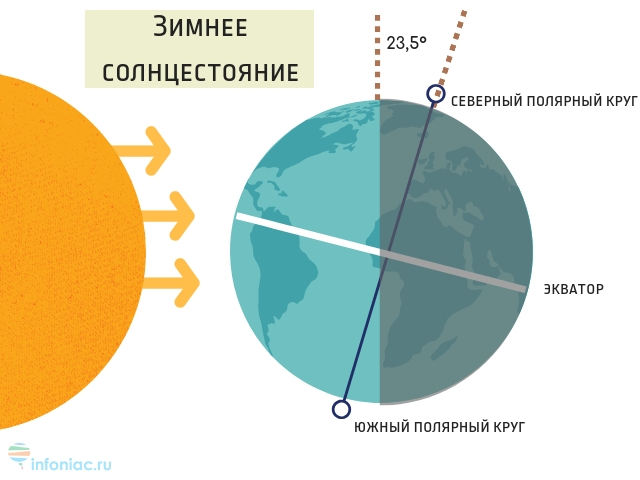
The winter solstice occurs not only on a certain day, but also at a certain time of the day, when the Earth's axis tilt relative to the Sun is 23.5 degrees. In the northern hemisphere, the Sun is at its lowest position above the horizon, and beyond the Arctic Circle, the Sun does not even rise above the horizon.
3. The longest night and shortest day in the northern hemisphere
As the winter solstice approaches, daytime shortens and gradually lengthens afterwards. The winter solstice in the northern hemisphere has the shortest day and the longest night.
For example, in Moscow, the day length during the winter solstice will be 7h 0m 20s compared to 17h 33m 40s during the summer solstice. In Helsinki, Finland, the day will last 5 hours 49 minutes, and in Murmansk there will be no sunrise at all — you can watch the polar night there.
4. Ancient cultures considered the winter solstice a time of death and revival
The seeming death of light and the real threat of famine during the winter months were a heavy burden for many cultures. Therefore, various festivals were often held at this time, calling for the return of the Sun and hope for a new life.
During the rituals, lights were lit and cattle were sacrificed, followed by a feast with the last fresh meat. The druid tradition honored the death of the old Sun and the birth of a new Sun.
Read also: Calendar of important astronomical events in 2018
5. The day was marked by new and unusual discoveries
Interestingly, on this day in 1898, Pierre and Marie Curie discovered radium, marking the beginning of the atomic age. And on December 21, 1968, Apollo 8 was launched when humans first entered lunar orbit and reached the Moon.
6. The word “solstice” is translated as “the sun is still”
This is due to the Sun's position in the sky relative to the horizon at noon, which rises or falls throughout the year, and feels like it stops at solstice.
We are currently looking at this phenomenon from the point of view of its cosmic location. In ancient times, people thought about the Sun's trajectory, how long it had been in the sky, and what light it cast off.
7. Stonehenge is aligned with the sunset line on the winter solstice
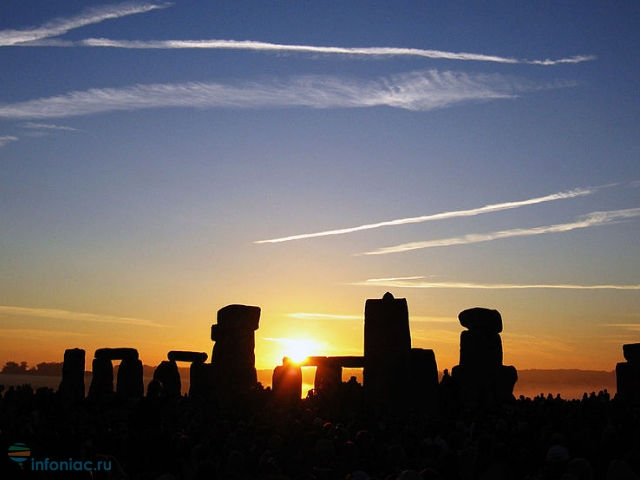
For a long time, for many people, the famous Stonehenge monument was a kind of sundial. Its main axis is aimed at sunset, while another Newgrange monument points to the sunrise line during the winter solstice.
Although the purpose of this ancient structure is still controversial, it is still of great importance during the winter solstice, bringing together many people from around the world for celebrating this event.
Winter Solstice Festival
8. The ancient Romans celebrated the holiday of changing roles — Saturnalia
At this time, they celebrated Saturnalia, when everything turned upside down. Social roles changed, gentlemen served slaves, and slaves were allowed to insult their masters. The holiday was named after the god Saturn, the patron saint of agriculture.
Wearing masks and pretending was also part of Saturnalia, where every house chose a binge king. Over time, Saturnalia was replaced by Christmas, although many of its traditions in the West migrated to Christmas.
9. Many believed that dark spirits walk on the ground during the winter solstice
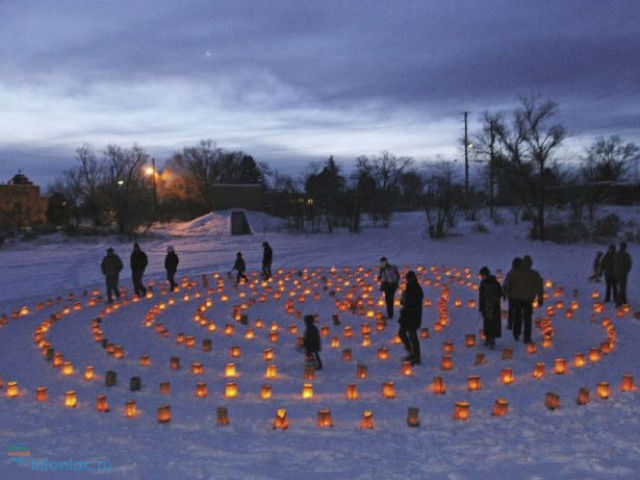
The ancient Iranian holiday Yalda, which is celebrated on the longest night of the year, heralded the birth of the ancient sun god and his victory over darkness.
The Zoroastrians believed that evil spirits were roaming the earth that day. People tried to spend most of the night in each other's company, having feasts, conversations, telling stories and poems to avoid any encounter with dark entities.
Celtic and Germanic folklore also speaks about the presence of evil spirits on the longest night.
10. The winter solstice of 2012 foreshadowed the end of the world
December 21, 2012 corresponds to 13.0.0.0.0 in the Mesoamerican long-count calendar used by the ancient Mayans. It meant the end of the 5126-year cycle. Many believed that such a combination of circumstances would lead to the end of the world or another cataclysm.
Read also: The most interesting thing about the ends of the world: the story of failed predictions
Others believed that on December 21, one era would end and a new era of profound changes would begin for the Earth and its inhabitants.