
 Science
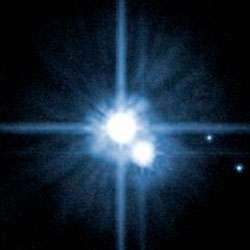
Last week, it was reported that the “non-planet” Pluto warmed another satellite near it. A new object orbiting Pluto was seen using the Hubble Space Telescope, and another one was added to the four previously known satellites. But is it really by four?
Now, new hypotheses have emerged. For example, that Pluto actually had not 4 satellites before, but 3 that were discovered by the same Hubble telescope over the past 7 years. However, the fourth object, named Charon, which was discovered in 1978 and was considered to be Pluto's moon, is now questionable. This object could be a planet in its own right.
Charon's mass is 12 percent of Pluto's mass. This might not seem like much, but the Moon's mass, for example, is only 1 percent of Earth's mass. Pluto's other moons are very small compared to Pluto itself.
Because of this mass ratio, Pluto and Charon seem to waltze around the common central mass. The same thing happens with the Earth and the Moon, but the center of gravity in this case is within the Earth's radius. If an outside observer looked at the Moon and Earth from the outside, he might also assume that these objects look like a “double planet”.
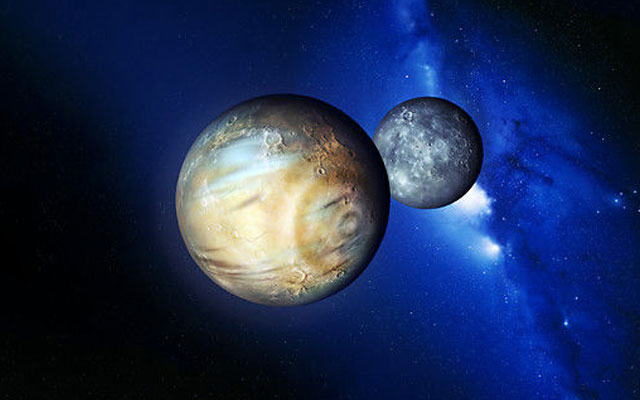
The rest of Pluto's moons, except Charon, do not exactly orbit Pluto, but follow Kepler orbits, that is, they revolve around the center of gravity, which is located between Pluto and Charon. Pluto and Charon make a full orbit around each other in 6.3 days.
This phenomenon is observed in binary star systems. About half of the stars in our galaxy are actually binary systems. It is believed that they were formed due to the fragmentation of a scattering nebula, whose particles began to clump to form bodies such as stars.
Dozens of binary asteroids have been documented since 1993. They could be formed when bodies were divided into fragments or as a result of collisions between different cosmic bodies. Why is it impossible for double planets to exist? A popular theory says that Charon and Pluto's other moons were formed when it collided with another icy dwarf planet.

According to a similar theory, our planet's moon formed about 4.4 billion years ago, although this theory has recently been questioned. There may be other binary planets somewhere, but so far no such system has been seen. These systems may be located outside debris belts, such as the asteroid belt and the Kuiper belt, where Pluto was actually discovered.
However, astronomers are still hopeful that binary planets might exist and that they might be habitable. The interaction between these worlds could be very interesting. The possibility that Pluto and Charon could be a binary system of planets was written back in 2006, but this hypothesis was somehow hushed up. By the way, Hollywood screenwriters have already taken this opportunity; in September, a new science fiction film “Parallel Worlds” is released, which tells about events taking place on two planets, who are drawn close to each other.