
 Science
Pluto's newly discovered moons could pose a threat to NASA's New Horizons spacecraft, which is on its way to the dwarf planet, scientists said. This ship was launched 7 years ago to explore Pluto. It should cross the solar system and reach its extreme planet in 9.5 years.
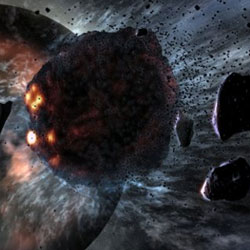
But since this probe was launched, astronomers have discovered two more moons that orbit Pluto's dark, icy world. This increases the risk that dangerous debris in Pluto's orbit could collide with the ship and damage it.
“We're finding more and more Pluto's moons — that number has reached 5 today,” says Dr. Alan Stern, chief scientist at the New Horizons mission. “We can assess these satellites are sources of space debris that orbits Pluto, as satellites can collide with small Kuiper Belt objects, resulting in smaller ones shards.”

The satellites of Pluto known to date are Charon, Hydra, Nix S/2011 P 1 and S/2012 P 1. Charon was discovered in 1978, Hydra and Nix in 2005, when the mission was just getting ready to launch. In 2011, the Hubble Space Telescope discovered two more smaller satellites, S/2011 P 1 and S/2012 P.
Scientists say that because the New Horizons spacecraft is moving too fast — at a speed of about 16 kilometers per second, it collides with a small pebble or even a millimeter-sized grain of sand could damage or even destroy the ship. It is necessary to stay away from areas around Pluto where debris can accumulate.
Scientists use computer simulations, ground-based telescopes and the Hubble Space Telescope to search for small objects orbiting the dwarf planet.
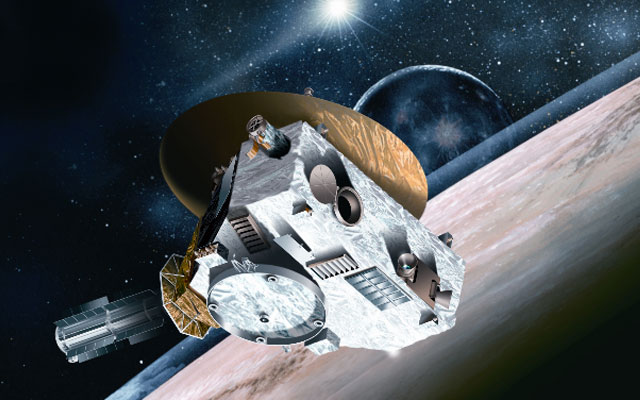
At the same time, researchers are planning alternative, longer routes through the Pluto system that will allow missions to continue, but help avoid dangerous collisions if the current plan the flight will be unsuccessful.
New Horizons was launched on January 19, 2006 from Cape Canaveral in Florida. The ship is due to reach its destination on July 14, 2015 and approach Pluto. This is the first study of the Kuiper Belt planet, an area of outer space beyond Neptune's orbit that contains a lot of ice debris left over from the formation of the solar system.